• Skip to primary navigation
  • Skip to main content
Danny Brown

Danny Brown

podcaster - author - creator

  • About
  • Podcasts
  • Journal

Archives for October 2008

Harness the Power of Stumbleupon with a Social Media Group

One of the social media tools growing in popularity and use is Stumbleupon. A simple yet effective application, Stumbleupon allows users to find random sites on the Internet either by recommendation from other Stumblers, or by happening across it by accident – all with the click of the Stumble button on your web browser.

It’s also one the most effective tools for web traffic in social media – yet Stumbleupon is still being underused by many, despite having the power to increase your web traffic by several hundred per cent. However, there are ways to make sure you’re utilizing all that Stumbleupon has to offer.

Start a Social Media Group for Stumblers

I can’t take credit for this idea – it was suggested by an online friend of mine and I was invited to participate. Yet the idea is so simple I’m surprised no-one else has picked up on it yet. Simply, gather a group of friends and create a social media group (not to be confused with the excellent social media clubs you can find online).

By gathering a number of online friends that use Stumbleupon as a social media tool and emailing each other a couple of blog posts or links each week to Stumble and recommend, you’re instantly getting new traffic to your recommended link. It also means you’re reaching new Stumblers through your friends, who can help you grow both your Stumbleupon and social media network.

To make sure it works to its maximum, keep the email requests to just a couple a week, and have your social media group at no more than 50 members. That means you only have to Stumble a maximum of 100 recommendations per week (including your own) which takes no time at all.

Use a Stumbleupon Widget

Although all blogs should really have some form of Share This or Add This widget at the bottom of each post – which allows readers to recommend the post to their friends – not all of them do. This is missing out on a great opportunity for your blog to reach a far wider audience – the Share This button allows the post to be shared on Digg, Technorati, Facebook and much more.

However, if you simply don’t like having too much clutter on your blog post, at least have the option to Stumble the post. This will see it being recommended to that reader’s Stumbleupon subscribers, which again will see you enjoy an immediate traffic spike.

(As an example, whenever one of my posts is Stumbled, I usually receive anywhere between a couple of hundred to over a thousand new reads. The more popular blogs receive several thousand new hits, so you can see the potential for business marketing as well).

The great thing about Stumbleupon is that once your blog has been stumbled the once, it offers a passive traffic flow for as long as your blog or post is live. Any time someone online hits their Stumble button, they could be taken to your original post. That’s just as good as any Pay-per-Click or AdWords campaign that I can think off – best of all, it’s free.

If you’re truly interested in all social media offers, Stumbleupon is one of the tools that you really should have a look at. Its potential for business is also only just beginning to be realized – be there when it happens.
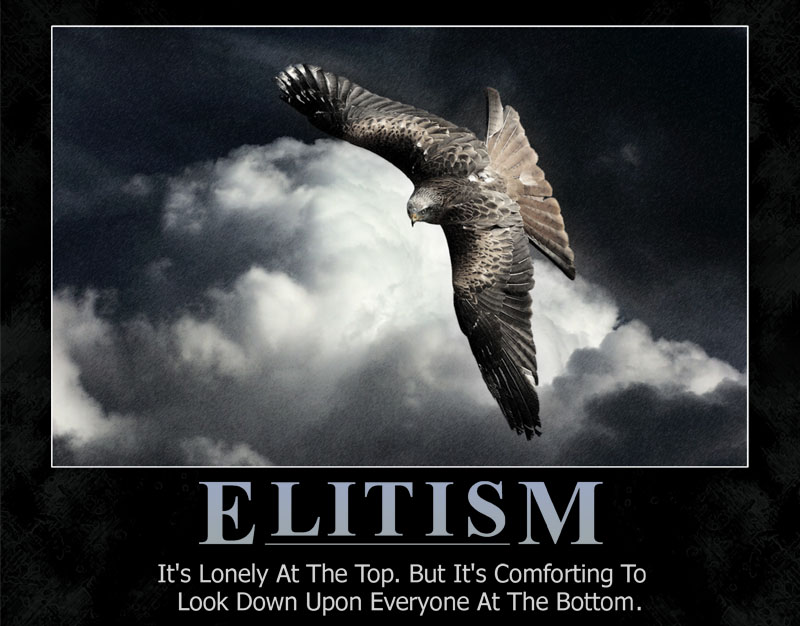
The Growing Elitism of Social Media

Recently I questioned whether we were turning into social media snobs. This wasn’t an attack on social media per se – more a valid look at whether certain people in the social media arena were beginning to try and wield a little too much (and possibly unwanted) influence over the medium.

However, perhaps even more disappointing than snobbery is the elitism that seems to be creeping into social media as well. While they may share certain characteristics, they are two different beasts.

Instead of the “do as I do” approach I discussed in my snobbery post, there’s a growing trend of “I want to feel more important than you” elitism that’s becoming more apparent.

A good example is the Twitter phenomenon. At its heart, it’s an excellent tool to not only make new friends and potential business contacts – it’s also a great way to see a microscopic snapshot of someone’s life in nibble-sized chunks. The fact that Twitter only allows you 140 characters to say your piece means you have to use that space wisely. This can lead to some very inventive and humorous comments.

Yet lately Twitter has become nothing more than a virtual brothel for people to either whore themselves out or to come across as a “look at me, I’m great” type of person. As a fan of social media and all it can offer, I find that sad and a little disappointing.

I’ll be the first to admit that I’ll notify my fellow Twitter users/followers of a new blog post – but then, that’s fairly standard for pretty much everyone on Twitter.

Where the application is losing its appeal (for me) is the amount of people that shout out about how many followers they have, or how many more they need to reach 500, or 1,000, or something similar. When did Twitter become a popularity contest? Isn’t that what MySpace is for (and one of the reasons Facebook is starting to take over from the Fox-backed networking site as the most popular)?

Maybe it’s just me, but I can see from your Twitter profile how many followers you have, or how many people you are following. That doesn’t interest me – and judging by the reaction of some of my friends who have stopped following certain Twitter accounts, it doesn’t impress them either.

Instead, tell people about excellent sites or blogs they should be checking out. Tell them about tools they can use to make them more effective in either their online brand building or improving their social media awareness.

Constantly mentioning you have so many followers often emits an air of superiority that no-one really enjoys and can lead to them unsubscribing from your updates. Which kind of goes against all that social media stands for, no?

The A-Z of Social Media Part 1 – Michael Arrington

As social media begins to find its feet, so the major players in it stand out – Michael Arrington is one such player. Widely recognized as one of the more “vocal” inhabitants of the social media world, Michael Arrington is undoubtedly one of the more successful proponents of it as well.

He is the founder of TechCrunch, one of the leading weblogs dedicated to profiling new Internet companies and products as well as those that are making a cultural impact on the Internet. From a small beginning as just another blog, TechCrunch has been built by Arrington and his team into a site that is consistently featured in online Top 100 lists.

As well as TechCrunch, Michael Arrington has also been involved in numerous other social media start-ups. These include OmniDrive, Dogster and Seesmic amongst others. This has led to Arrington being named as one of the most influential people on the Web.

As much as he is respected for his role in online and social media development, Michael Arrington also draws his fair share of criticism as well – most notably, that he often uses TechCrunch as nothing more than a soap box for his Silicon Valley friends. He’s also been criticised for posting stories on TechCrunch and lambasting people without knowing all the facts, as the debate about a recent story regarding a dying ex-corporate lawyer attests to.

Whether you’re a fan of Arrington or feel he’s been overhyped by both the mainstream and specialist media, there’s no denying the part played by both him and his companies in the rise of social media as a viable medium. For that alone, he deserves his part in the A-Z of social media.

If you enjoyed this post, please consider leaving a comment and subscribe to my RSS feed or via email to ensure you can enjoy the latest post(s).

Are We Turning into Social Media Snobs?

From its inception, social media has always been about the romantic notion of connectivity. Full connectivity. Whether it?s being able to interact with the Internet in a more open manner than we?d ever known previously, or connecting with other like-minded people to share, advise and learn, social media and full connectivity have gone hand in hand. Until now.

I read a lot of blogs – some by the biggest names in social media, some by the rising stars, and some that are just entertaining reads by people starting to find their feet in this whole social media world. Then there are the non-niche blogs that are worth anybody?s time.

What I like most about these blogs (and the others that are recommended to me by friends) is the openness and free-to-all approach that they offer the reader. There?s no hidden agenda here – simply the proponents of social media and those interested in it, sharing views along the way.

Recently though, I?ve been leaving many of these blogs with the feeling that the authors are beginning to believe a little bit too much in their own hype. Instead of sharing openly with their readers and asking for opinions on how they view social media, the authors are instead preaching how to approach the medium.

This would be okay if it was merely helpful advice from someone who?s been there and done that. Sadly, it?s becoming less so. Instead, we?re treated to people virtually attacking the medium that gave them such a popular voice to begin with.

Example – there?s a particularly well-known tech blogger that recently chastised other bloggers for not name-checking thousands of blogs a day, or for not using tools like Google Reader in their sidebar to let other bloggers know what they?re currently reading. This irks me.

Not everyone is (or wants to be) a professional blogger. Many simply use the medium for sharing their innermost thoughts with a curious world. So what if someone doesn?t want to link to another blog, or website, just for the sake of linking? Does that make them any less of a person (or blogger)? Does it mean they don?t deserve to be mentioned in the same breath as this tech blogger that raised the point in the first place?

Of course not.

There are many ways that bloggers can show appreciation of the work of others without blatant shout-outs and name checks all the time. Blogrolls, or links, for example. Or using an application like CommentLuv, that shows the last blog post of anyone leaving a comment.

Blogging shouldn’t be a private playground where the ?privileged few? set the rules. Nor should social media. Instead, both should be methods of bringing people together to ultimately make the world a friendlier and better place. Shouldn?t we try keep it that way, before the snobs ruin it for everyone?

Blog Action Day and Social Media – The Perfect Combination

When I sat down to write this post for Blog Action Day 2008, I’ll be honest – I wasn’t sure what exactly I was going to say. Don’t get me wrong – I knew the reasons why I was participating and writing, and I knew roughly what I wanted to say. It was just… how could I convey a message against poverty from a social media viewpoint? And then it hit me – Blog Action Day 2008 and social media are intertwined because we’re all in this together.

I don’t want that comment to come across as glib – that is the last thing I would ever do, or want to be thought as. When I say we’re all in this together, I mean that the social media medium is probably the ideal partner to the changes and issues that Blog Action Day 2008 is having us all discuss.

(For anyone who hasn’t heard about Blog Action Day 2008, it’s a special one-day event for bloggers around the world to stand up and speak out against world poverty).

Apart from the obvious connection of writing a blog post, there is so much more that social media can offer to begin the changes we need to put in place to make a difference. The figures alone from Blog Action Day 2008’s website bear testament to this – 10,723 blog owners (at time of writing this) writing posts on a single subject, with an expected readership of just over 11.5 million people.

But we shouldn’t stop there. There is so much more we can all do, and as a social media advocate there’s a lot that I feel our particular medium can do as well. One of the great things about social media is it gives everyone with an Internet connection a voice – and that’s a pretty powerful thing. If you want an example of how powerful, just look at how serious the US election candidates are taking social media and networking.

So what can we do with this voice, this collection of opinions and influence? The first thing to do is make sure that Blog Action Day (and the similarly themed Bloggers Unite initiative next month) isn’t just an annual event. We need to keep people informed as much as we can throughout the year; we need to make the people that have the power to make a change hear enough of us to do so.

For my part, this is what I will do from today:

  • For every unique comment received on this post and every post between now and the end of the year, I will donate $0.10 to the Make Poverty History fund. Then, each year end from today, I will continue to donate $0.10 for every unique comment left.
  • With every new project I take on at my PR agency, I will donate 5% of my fee to the fund.
  • I will continue to make posts to keep awareness of poverty, its cause and effects via my blog and beyond
  • I have a project that I have in mind regarding this subject, and will share with you all shortly and ask for support.

This is my personal donation to Blog Action Day 2008 and beyond. At the end of each year, I will let you know how much was donated. Yet as I said, we’re all in this together. Social media brings everyone together, so let’s open up our arms and bring in the poverty-stricken of the world into our network.

For your part, it’s entirely up to you what you wish to contribute. It may be a donation to a worthy cause like Make Poverty History. It may be that you offer pledges yourself for the comments on your blog. It may be something as simple as getting two cookies at the coffee shop and giving one to the next homeless person you see. After all, poverty affects each and every country.

Whatever you do, make sure you do something. It’s taken Blog Action Day 2008 to open up a lot of people’s eyes to what’s going on in the world. Let’s make sure that we never have to discuss poverty again, unless it’s with our politicians. In the meantime, let’s be grateful for programs like Blog Action Day 2008 and make our voices heard.

If you enjoyed this post, please consider leaving a comment and subscribe to my RSS feed or via email to ensure you can enjoy the latest post(s).

  • « Go to Previous Page
  • Page 1
  • Page 2
  • Page 3
  • Page 4
  • Page 5
  • Go to Next Page »
© 2026 Danny Brown - Made with ♥ on Genesis