
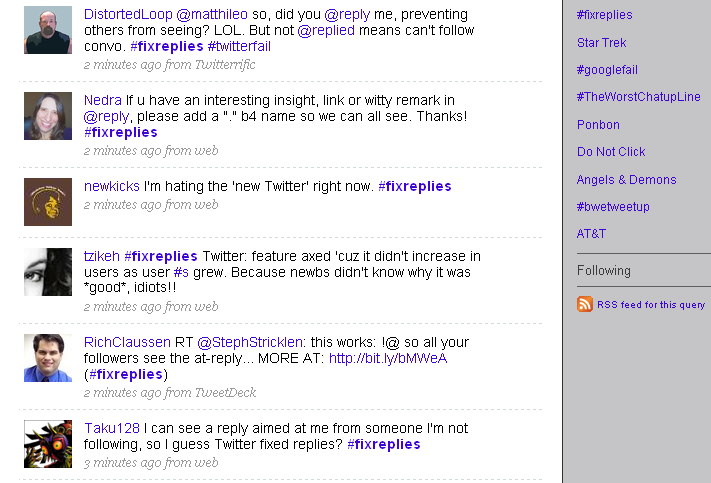
 It’s been quite a few days for social networking site Twitter.
Many users are up in arms about a recent change that Twitter implemented regarding replies to other users.
I’ll be the first to admit that, originally, I thought it was a major overreaction on the part of the users who were complaining the loudest. After all, the problem stemmed from something that was never a part of Twitter’s original toolset.
So, to take the stance that a lot of users were taking (abuse and bile directed at the Twitter team being just part of the response) seemed an ineffective way to try and make a point.
There are still people doing that, and I don’t think it helps the situation. But that’s by the by. What is clear now is that there are two very distinct sides to this situation, and both have merit.
Twitter Is Right
The reasoning behind Twitter’s “meddling” with the reply system is that it can be confusing. They discussed this very topic over a year ago on their blog – unless you’re up to speed on Twitter’s kinks and terminology, it can be a very confusing place. Hashtags, @’s, RT’s and? tweetchats are just some of the idiosyncrasies that await users.
As Twitter looks to find the model it needs to succeed from a business point of view – and it is still primarily a business model in progress – it needs to be as accessible and as easy to use for the majority as possible. This means having less confusion, which Twitter thought the reply system caused.
Cue the amendment and subsequent Twitter user backlash.
Twitter is Wrong
One of the effects that the new Twitter reply system has had is that it’s effectively blacked out the feed of many Twitter users. Whereas before you could see a friend’s conversation to another user even if you weren’t following that other user, now you no longer have that luxury.
So this means that users that only follow a small amount of other users will have a very barren feed. This was pointed out really well to me by one of my closest people on Twitter, and something I may not have realized initially (sorry, Freddly!).
So, instead of seeing all the conversations that I’m having with everyone I’m connected to (and possibly checking them out as well), Freddly can only see the conversation if it’s to someone she mutually follows. This is where the new Twitter reply option is letting users down.
Those of us with a lot of connections will be fine – others, not so much.
Endgame
So, what’s the solution? There are a lot of angry people around, and this is leading to a lot of friction on both sides. The pro-change camp say that you can still find new people using the search option, and if you don’t hit the Reply button then everyone following you will see the message.
The anti-change camp suggest that it’s nothing less than censorship and that Twitter is bowing down to the celebrities and post-Oprah crowd. They suggest boycotting Twitter until the old reply function is reinstalled.

Twitter, for their part, are listening to the criticism (constructive and otherwise) and trying to appease users with halfway house solutions.
Bloggers are sharing their views, some calmly and sensibly, others not so much. It’s a touchy subject and one that’s causing a lot of heat in the Twitter feeds.
From my own perspective, it doesn’t affect me as much as it may others. The people I’m connected with and converse with are mostly mutual connections to others, so the conversation hasn’t really been affected on my feed.
But, I can see why this isn’t the case for people like Freddly, and on that count, Twitter seems to have messed up a key part of the user experience. It’s clear to see that there’s some major work ahead for Twitter to try and satisfy both camps.
In the meantime, though, I’m not sure if the mob mentality will help or hinder this process. And seeing some of the Twitter power users asking “Social Media or Social Control?” seems sensationalist.
How about you? What’s your take and where does Twitter go from here?
 photo credit: Archie McPhee Seattle