• Skip to primary navigation
  • Skip to main content
Danny Brown

Danny Brown

podcaster - author - creator

  • About
  • Podcasts
  • Journal

Influence

Stop Scoring Influence, Start Creating Influence Paths

Disruptive influence

A few months ago, I sat down with?Steven Sefton, Digital and Social Media Director for?Zap Designs, to discuss a variety of topics including the differences in cultural marketing based on location; the changing face of influence; where influence marketing is heading; and much, much more.

Below, you can find part two of that chat (which?originally appeared?on The Social Penguin), centred around influence marketing, the need to move away from generic social scores, and how brands are focusing on the wrong “influencer”.

I hope you enjoy, and you can find the first part of the interview?here.

?????????

You?ve written the book Influence Marketing with Sam Fiorella. What made you?write this book?

It was a mix of being disappointed at what was classed as influence today ? social?scoring platforms like Klout ? and the realization that businesses would continue?to get poor results from that kind of ?influence marketing?. The focus was on?the wrong people ? it?s not influencers that make your brand successful, it?s?customers.

We wanted to take back influence, if you like, from non-descript social scoring?algorithms, and place the focus back squarely on the customer. Understand?where they are in the purchase life cycle, and who impacts their decisions at that?point. Understand that, and you know who you truly need to connect with and?how that person can help sway your customer?s thinking, and move them along?the purchase path to the next phase, whether that?s Awareness, Research, Intent?to Buy or something else.

How do you see influence marketing changing in the future?

Moving past scoring platforms and truly understanding what your customer?needs, and working back from there to find who influences them and how. We?re?tired of empty metrics likes impressions and social shares ? we need to see real?deliverables from our investments.

This is why scoring platforms fall down when?it comes to real influence ? they lack the data and connections that show the real?context behind a relationship. The likes of Klout are selling social impressions,?nothing more.

Do you think it?s going to become harder or easier to find relevant influencers?

If brands are willing to put in the legwork and avoid the quick-hit buzz-driven?approach to influence, it does actually become easier. Instead of generic, scoredriven ?influencers?, you?re identifying those that truly impact your customer?s?decision-making process, no matter where they are in the purchase life cycle.

This works at every level ? the brand isn?t paying for non-targeted campaigns,?and has a far higher rate of success, and the customer is being helped at the?exact point they need that help to make their decision. It?s not rocket science?to run successful influence marketing campaigns; it?s just that some folks and?technology vendors would have you think it is.

Can you be an influencer in many areas or will it come down to the super niches?

That?s the beauty of bypassing today?s ?social scoring as influence? model,?and really understanding what influence is and how to identify who really is?influential. Klout goes for the topic approach ? but that?s too generic, because?human beings are way too complex to be tied to just a few topics.

Mindsets?change based on peer pressure ? does a guy start to try and like Justin Bieber to?influence how a girl he?s interested in looks at him? That?s a simplistic example,?but a valid one about the problems facing influence today.

Because real influence is based on who and what sways decisions at a given?time in a person?s life, we are all influential in multiple areas. I?m not a??daddy blogger?, but I have two kids under four years old, a boy and a girl.

My?experience in this area would mean I may be able to offer insights into what?it takes to raise two toddlers, but I?d never be picked up by scoring platforms?because I?m viewed as a marketer, or whatever.

THAT, for me, is where influence is going and needs to be ? our topics and level?of knowledge around these topics change all the time. So, because of that, niches?aren?t needed ? understanding of where we are in life is, and offers the bigger?return.

How can brands better adopt influence marketing as a tactic?

Simple ? buy our book!! Failing that?

Our studies, and discussions with both?brands and organizations, show that they?re still in the mindset that scoring is?the best way to run influence marketing campaigns, promotions, call it what you?will. While they can offer a decent starting point, you need to go deeper than the?data they offer to really start to understand true influence.

Additionally, brands are still seeing influence marketing as a buzz creator, and?using it with the mindset of short-term campaigns. Influence offers so much?more than this, and should really be used to move towards advocacy and longterm relationship building.

By using the methodology outlined in the book, and really understanding who?influences your customers the most, and how that maps back to your goals, it?becomes less a hit-and-hope tactic and more a defined, results-driven strategy.

To steal a line from the book, brands need to stop scoring influence, and start?creating influence paths.

Crafting an Influence Marketing Strategy Through Data Mining

Data on influence

In the Influence Marketing book, we spend a lot of time diving into the field of big data – specifically, text analytics, ontology, and predictive analytics (hey, we never said it was an easy read!).

For both Sam Fiorella and myself, these disciplines are key to running true influence marketing campaigns, and identifying real influential conversations as opposed to amplified noise through inflated social scores.

As more data becomes available to us, so the nuances of that data become more clear, and we can begin to isolate key terms, phrases and even slang to target the ideal audience for our brand messaging (not to mention those who can disseminate that message to an even wider audience).

A recent infographic, collated by the New Jersey Institute of Technology, shares a deeper dive into the mechanics of data mining and why it’s such a powerful toolset not just for influence marketing, but marketing and customer acquisition in general.

Which, at the end of the day, is exactly the message we share in the book when it comes to the direction influence marketing needs to take if it’s to reach its potential and move beyond the likes of Klout and its ilk.

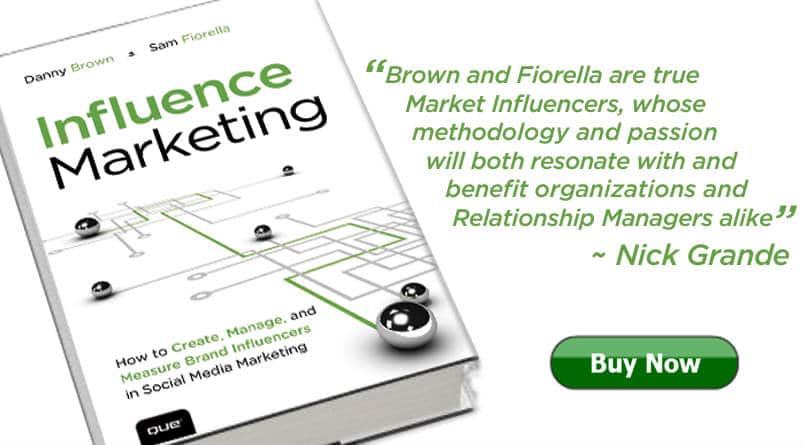
Enjoy the infographic. And if you want to learn how to use the information in the infographic for your influence marketing strategies, simply click on the “Buy Now” book box at the end of this post… 😉

NJIT New Jersey Institute of Technology ? Online MBA

Influence Marketing Vendors Are Letting Influencers and Clients Down

Danny Brown blog

Back in 2009, social media was just starting to become popular for marketers and brands to work with social media power users to promote their services and products.

Companies like IZEA saw an opportunity to attract people with large social followings or blog subscribers, and offer them money or free products for access to their audience.

Suddenly, Twitter was awash with tweets that were essentially ads, and blogs were rife with content that had been paid for. The problem was, no-one knew this because there was no legal requirement for that sponsored relationship to be disclosed. Instead, it was up to the blogger or “social influencer” to decide whether to disclose or not.

Due to the duplicitous nature of this lack of disclosure – essentially, it’s false advertising and gives brands an unfair advantage over competitors – regulatory bodies stepped in.

In the U.S., the Federal Trade Commission (FTC) published regulations stipulating paid or sponsored content had to be disclosed. Failure to do so would result in fines for brands in the region of $100,000 and up. Bloggers would be safe from this kind of fine (for now, at least).

In the U.K., the Advertising Standards Agency (ASA) is less forgiving, and sees bloggers equally as responsible as the brands they’re working for. If a blogger is found to have promoted sponsored content without disclosure, there are various sanctions they may face.

While I agree that bloggers who deliberately skirt the rules should be punished, I can’t help but feel the vendors they’re working with are letting them down. Case in point – Triberr.

Home of (Grey Area) Influence

Triberr started out as an automated content curation platform, where bloggers could join “Tribes” and share each other’s posts, the idea being to gain more traffic from the extra army of bloggers and their audience you’ve created a Tribe with.

Recently, though, Triberr pivoted and became the self-proclaimed “Home of Influencers”.

Influencer Marketing Campaigns - Triberr

To their credit, they had an interesting approach – brands would create self-served campaigns (where they themselves created the timelines, offers, compensation, etc.) and then open it up to the relevant Triberr members.

Triberr wouldn’t charge for this service. Instead, they’d take a percentage of the final payout the influencers received. Compared to the costs involved with a Klout Perks campaign, this is a far more attractive proposition for both brand and blogger. The brand doesn’t have to pay exorbitant fees, and the blogger makes a decent income.

The problem is, Triberr doesn’t seem to be doing too great a job at educating on disclosure, as per the FTC, ASA and similar governing bodies in Canada, Australia and elsewhere. In fact, disclosure seems to be a bit of a grey area.

When the Blogger Doesn’t Know About Disclosure

I recently read a blog post by a blogger I’ve been reading for a while, about a brand offering a pretty cool publishing service for new media. As I read the post, it became pretty clear (to me) that it was sponsored content.

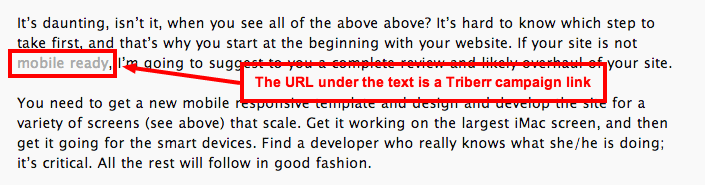
Things like contextual keyword linking (where a certain phrase is used as a hyperlink versus the brand name itself), the way the post flowed compared to this blogger’s other posts, and the fact it simply read like a non-connected promotion. To confirm my guess, I checked the link for the contextual keyword (mobile ready) and, sure enough, the URL was clearly a campaign link.

Triberr campaign link

This would have been fine – had there been any disclosure to alert readers this wasn’t a normal post, but a sponsored one where a brand had paid the blogger to promote them. Unfortunately, there was zero disclosure anywhere.

I noticed that the blogger had more than one post about this brand, so I checked that one too. The same: contextual keyword with a Triberr campaign link, and no disclosure.

I decided to first hop on over to Triberr and see what they say about disclosure, but it’s pretty difficult to find anything if you’re not logged into their system.

I did find a blog post by Triberr co-founder Dino Dogan, that shares this advice about disclosure:

Disclosure is a hugely important part of brand ambassadorship.?They don?t have to be generic and boring. You don?t have to be ashamed of being affiliated with a company. In fact, if you are ashamed, you have a choice. You can go and represent a different company.

While Dino mentions the importance of disclosure, there aren?t any guidelines in the post on how disclosure should be approached. Indeed, when referring to a sponsored post Dino uses as a great example of a campaign post, he states:

Somewhere in the middle of the article I disclose how the post came about.

This is a red flag. As per the FTC mandate, disclosures should be highly visible:

  • Prominence: Disclosures must be prominent, viewable on any device, and not buried within a web page (in the March 2013 update, the FTC stated disclosure must be at the start and end of each post). Fine print may not cut it, and prominence is even required on a mobile web page. (Source: Social Media Explorer)

The key phrases that stand out here are “disclosures must be prominent” and “not buried within a web page”. The post Dino referenced had the disclosure “somewhere in the middle of the article”.

That raises the question, if the vendor isn’t “doing it right”, how are the bloggers being educated on the role of disclosure for a Triberr campaign? Judging by their latest campaign fine print, they’re not.

Triberr campaign blogger

As highlighted by the red box at the bottom of the campaign, it shares milestones and content expectations – but nothing about disclosure. I reached out to Triberr on Twitter a couple of days ago to ask about their disclosure policy:

How is @Triberr ensuring all sponsored posts disclosed? Just saw two campaign links, not disclosed, on PR blogger's posts.

— Danny Brown (@DannyBrown) December 10, 2013

With no response, I then contacted a blogger I knew to be working with Triberr to ask about their understanding of disclosure from Triberr, and this was the response:

Should bloggers know to do this? For sure! However, there’s an intense likelihood a writer has never been hired. Ignorance is naivet? in this regard. Companies using Triberr to reach influencers need to assume bloggers are unfamiliar with legal rulings. ?Triberr needs to write influencer guidelines for sponsored campaigns (their current “rules” are sketchy). Companies need to add their influencer guidelines to the mix. Bloggers need to both read and adhere to a disclaimer with approved language and positioning in each published piece.?No one wants to grapple with the law or be fined due to a simple inclusion of a disclaimer. Each of us needs to do a better job of protecting the other — bloggers, influencer networks (like Triberr) and those hiring and executing campaigns.

So, bloggers seem to be in the dark around what should and shouldn’t be posted. Perhaps this isn’t surprising – there really is no easily found disclosure area for bloggers to reference. The closest I found was from this FAQ sub-post (click to expand):

Triberr declaration post

While it mentions a Declaration Post sets off a relationship with transparency, any visitors to the blog that are only reading the sponsored post and are unaware of the Declaration Post will still be unaware of the content being sponsored, thus leaving the FTC guidelines unaddressed.

But bloggers aren’t the target (at least not for the FTC – the ASA would beg to differ). Instead, the FTC is more concerned about brands – so how does Triberr educate its brand partners?

The Non-Existent (Public) Disclosure Education for Brands

To find out, I created a dummy campaign on Triberr using the self-serve campaign creator. I simply entered some “Test” copy for each of the campaign areas, and clicked through each next step until I got to the point where I could review my campaign before setting it live.

At no point did I receive any advice about making sure I was aware of disclosure rules and guidelines. Nor was there any copy provided by Triberr that I could use for my Fine Print area (where Disclosure would be a prime candidate for inclusion).

Instead, I simply had the opportunity to insert my own fine print, and then set the campaign live.

Triberr for brands

Because this is a self-serving campaign, the brand (me) would be putting themselves in jeopardy by not stating upfront that partner bloggers need to disclose in any content they share (and not just blog posts – social updates, too, if they link directly to the brand).

With fines of up to six figures, this is an expensive oversight on the part of Triberr. There needs to be clear and upfront education, advice, copy, etc., that pinpoints the requirement of disclosure and how to make sure your blog partners are aware of their responsibilities in this area. If that is currently there, it’s very difficult to find (I couldn’t, after an hour of going through various links).

ftc disclosure   Search Results   Triberr Knowledge Base   Help Center

Without this, Triberr’s bloggers are short-changing their readers through no fault of their own. Worse, the clients using Triberr’s influence marketing service are essentially breaking the law, and if a fine isn’t bad enough, the hit to their reputation could be.

I’ve reached out to Dino Dogan for the Triberr take on disclosure and how they’re educating and enforcing (if at all). I’ll update the post accordingly if I hear back.

Does Influence Marketing Have a Future?

Robots replacing humans

Earlier this year, Forbes published an article entitled Who Are the Top 50 Social Media Power Influencers, 2013? by Haydn Shaughnessy. It followed similar posts by Shaughnessy on The Top 20 Women Social Media Influencers, also on Forbes, and a similar Top 50 list 12 months earlier.

The article soon came under fire from certain areas of the web, including Mark Schaefer’s Grow blog and Jure Klepic of the Huffington Post. Additionally, there were numerous conversations across the web on the Forbes article, with the majority of people discounting its validation.

So why did a publication like Forbes receive such criticism, and what does the discounting of influencer results like the one on Forbes mean for influence marketing in general?

Popularity is Not Influence

This is beginning to sound like a broken record, but popularity does not equal influence. While having 100,000 followers on Twitter might be a nice statement of your social proof (hint: it’s not really), does that make you influential (another hint: no)?

This is where the majority of the criticism of the Forbes article comes into play.

In his preamble to the list, Shaughnessy shares the “algorithm” behind identifying the influencers, and that he uses Twitter measurement platform Peek Analytics. That should raise the first red flag – Shaughnessy is only defining influence from a single platform.

However, it’s Peek Analytics’ own description that devalues Shaughnessy’s article even more. From the Peek Analytics website:

Social Pull is not a measure of a single individual?s ?influence;? rather, it is an audience-based metric that is a direct reflection of the quality and size of the Twitter audience that has been ?pulled? into following an account or mentioning a keyword @name, hashtag, or URL on Twitter.

So, Peek Analytics doesn’t measure influence; they measure data based on interactions. So why does Shaughnessy use a tracking platform that doesn’t measure influence to create an influencer list?

It’s this flawed approach that the majority of the criticism around the web has picked up on.

…this is a suspicious methodology to define social media influence, and that is about as charitable as I can be. – Mark Schaefer

With their tired standard of measuring Twitter followers, PeekAnalytics adds nothing to the conversation of influence measurement. Similar to every other list that has been made based solely on Twitter followers, there is no attention paid to the metrics of comments on their blogs, content quality and other social networks.?- Jure Klepic

…the thing that bothered me about the Forbes list is they clearly did it based on Twitter followers alone. There are two people on there I know, for a fact, they paid for their followers and don’t interact, engage, or build community. – Gini Dietrich

These criticisms, and others like them, clearly show that the social web has moved way beyond just numbers and a platform where spam bots are plentiful when it comes to defining influence in the truest sense.

Influence is Multi-Layered

The other core issue with the Forbes article is the very fact Shaughnessy limits measurement to a single platform. This is lazy analytics at best, allowing for flawed metrics to be used as a source of influence identification.

It’s also one of the reasons that an?influence marketing survey?from earlier this year of over 1,300 professionals highlighted the need for more accurate and informed data analysis, versus the approach currently taken by social scoring platforms.

Influence marketing survey key insights

For example, Klout’s algorithm only measures your public Twitter data – they need you to connect your other social accounts to offer any true accuracy. From a recent TechCrunch article:

Before we are able to incorporate any data into a person?s score, we need users to connect the network to Klout so we can begin to process the influence data.

So, much like Peek Analytics, they’re using a single platform to measure influence, as opposed to all the other social footprints you may have elsewhere. Klout competitor Kred is in the same boat:

To calculate your Kred, we analyze?billions of tweets?from the last 1,000 days.?We add your Facebook actions when you connect your account.

While there’s no doubt Twitter is an important part of the social media ecosystem, it’s just one piece in a very large puzzle. And it’s this reliance on Twitter data only that dilutes the effectiveness of social scoring when it comes to identifying true influence based on behavioural change, as opposed to reactions to a tweet.

Influence is much more than the sum of Twitter’s parts. If we, as marketers and brands, are looking to truly understand what drives actions in people – the definition of influencing someone – then we need to understand much more than a tweet or social network update.

  • Situational factors – what’s affecting someone’s decision-making at any given time?
  • Peer factors – who offers the most influence based on where you are in that decision-making process?
  • Financial – can you afford to buy, or are you more logical and prudent with your money?
  • Emotional – tied into the financial factor, does emotion for a product override common sense, logic and lack of funds?
  • Familial factors – who’s the decision-maker in the family and how does this impact a brand message being accepted?

These are just a few of the factors involved into identifying where influence may play a part, and who the influencer would be to instill the next part of the equation and, by association, action.

Is Influence Marketing Losing Its Clout?

So what does this mean for influence and influence marketing moving forward? Has the potential of influence already been nixed before it’s even had a chance to reach maturity?

After all, the criticism of a respected media publication like Forbes, as well as questions being raised on current social influence outreach and its effectiveness at ROI, would suggest influence is becoming a tainted topic.

And, to a degree, it is. Lack of results (shared or perceived) harm the medium, as brands (rightly so) look for return on their investments, beyond simple retweets and blog posts that add nothing to the bottom line.

However, as the results of the?influence marketing survey?I shared here show, it’s not influence itself that’s broken, but the definition of how we identify who influencers are today, and what they mean for a brand. Brands are still looking to use influence marketing as a key part of their tactics; but they do expect more.

The problem is we’re still placing “influencers” – whoever they may be – at the heart of the marketing circle, and not always defining what the context is when it comes to filtering them for a brand.

Disruptive influence

A simple example – Lifestyle Blogger A has a well-read blog, and primarily attracts an audience of women between the age of 25-44. So it makes sense that a brand whose demographics are made up of this audience should work with that blogger.

But the audience has a very different make-up. Blog Reader A is a single mom with two young kids under three; Blog Reader B is a married mom with one kid aged ten and one teenager; and Blog Reader C is a mom who has a child of college age, who’s no longer living at home.

All three of these reader segments fall within the broad category of “women between the age of 25-44” – but that’s where the similarities end.

Let’s say the brand sells toddler toys. Using a generic influence outreach campaign, the blogger might be successful at putting the brand in front of the Blog Reader A segment, but the message will be completely off-point for the other two, just-as-important segments.

This is the where the flaws of putting today’s definition of an influencer at the heart of the marketing circle appear, and why we need to move beyond this, and start putting the actual customer at the heart of the circle, and work back from there.

By taking this approach, we understand who the true influencers are – customers – and what they’re looking for, as well as who’s influencing their decisions at a specific point in time.

And if we can redefine influence to the people brands should really be taking notice of, and how to meet their needs and help with their decisions, we can reposition influence back to its true meaning and dispel its lack of effectiveness (perceived or real) currently “enjoyed” today.

A version of this post originally appeared on the official blog for the Influence Marketing book.

The Influence Marketing Book and Its Impact on the Influence Conversation

Influence Marketing bookWhen Sam Fiorella and I sat down to write Influence Marketing, we had a very defined goal as to what we wanted to achieve.

This ranged from the tone of the book itself, to the reaction of readers, to the long-term goals for uptake of the book’s methodology.

With Influence Marketing having just “celebrated” its six month anniversary since its publication date, I thought it might be fun/interesting to take a look back and see how the book’s not only been received, but also how our original goals have fared.

Influence Marketing Commercial Success

While both Sam and I were very much focused on the reaction to the methodology we present in the book, along with how readers could implement it within their own businesses, a book still has to sell to make the publisher’s investment worthwhile.

By the end of the first week of launch, Influence Marketing had shipped its complete first print run. This took us completely by surprise – while we had high hopes for sales, we weren’t expecting such a response.

I think this can be attributed down to our pre-launch strategy.

  • We created a Google+ community where we hosted regular Hangouts on the topic of influence marketing with various leaders in the space.
  • We created a series of whiteboard videos, that shared our belief in how today’s definition of influence had to change, and put the focus back on the customer.
  • We stayed away from the typical “Buy X amount of books in return for…” strategy (although we did offer some incentives post-launch) and instead worked with organizations, Social Media Clubs, and influence marketing platforms on live events where the book’s methodology could be dissected.
  • We released a carefully chosen free sample chapter that showed just how deep we were diving into the influence marketing conversation.
  • We carried out a survey of more than 1,300 marketing and PR professionals on where influence is today and where it needs to go.

By doing this, we offered information and insights into where the conversation around influence was headed, versus pure promotion. For us, this less direct approach culminated in the first week’s results as well as its healthy ongoing sales.

We’re grateful that the book has continued to be well received, and the other week saw it reach #1 on Amazon Canada! So thank you for your continued interest.

Amazon.ca Best Sellers Influence Marketing

Influence Marketing Critical Success

As grateful as Sam and I were with the commercial response, it’s the critical one that was always going to be the measuring stick for us. Yes, sales were (and are) important – but sales can be inflated, with authors paying companies to help them make the New York Times Bestseller lists, for example.

Critical success – how the book is received not only by the target audience, but also respected peers and publications in the industry – is, for authors, a more accurate reflection of how you met your goals.

Thankfully, we’ve seen some great results in this area too.

  • Nielsen BookScan recognized the book as one of its Top 100 Business Books in America.
  • Evy Wilkins, VP of Marketing for influence platform Traackr, quotes the book as having “…done nothing short of skyrocket the practice of influencer marketing from a misunderstood and poorly executed social media technique to a fully-fledged business necessity.”
  • The book has been picked up to be part of the curriculum at the likes of Georgetown University in Washington, U.S., and Seneca College in Toronto, Canada.

Georgetown University and Influence Marketing book

In addition, reviews on the likes of Amazon and blogs have universally alluded to the academic approach the book takes.

  • “This book is a serious read and hands down the best of any of the social media books I have read to date. Danny and Sam provide facts, case studies, examples, charts, data and concepts that will likely cause a shift in the way the reader thinks about influence marketing.” Christine DeGraff.
  • “This book went further into brand building and sales acquisition than I could have possibly imagined. This will be part of my favourite ‘evergreen’ books because, in the end, this book will be relevant for many, many years to come.” David Boozer.
  • “This is a deep read that’s not for the faint of heart. Bring coffee and plan to stay awhile. However, the result will be enlightenment regarding influence marketing that goes beyond a [social] score…” Brian Vickery.
  • “This book provides fantastic analysis and details for deploying social influence models that deliver the right results. Some may think the analysis is too academic but I disagree – the world of marketing and social media needs deeper thought [and substance]. The substance included in Influence Marketing will see the book have a shelf life of several years.” Brian Hansford.

While it might seem contrary to what authors should say, both Sam and I love hearing folks saying the book is a hard read, because it should be. Influence marketing – as well as marketing in itself – and understanding your customers takes hard work, research, and in-depth execution and measuring.

The fact this has been picked up by readers of the book is validation for Sam and I’s approach to how we wrote the book, and kudos to our publisher for allowing us to take this route versus making it a simpler read for the mass market.

Influence Marketing and What’s Next

However, this is just the start of the ongoing influence marketing conversation. While the book was the instigator of this conversation, the real “work”, if you like, is only just beginning.

We’ve seen influence platforms begin to adopt our methodology and, with the book being picked up to be used as part of academic curriculums, the next generation of marketers will be taking that methodology forward into new areas of implementation and discussion.

In the meantime, the Influence Marketing book website – and the various communities around it – will continue to be a living resource for the methodology and long-term goals of the book – to move influence marketing beyond just social influence and amplification, and into customer acquisition and real business ROI.

Coming soon, we’ll be presenting a very special webinar/workshop series with partners that are leading the way when it comes to where the influence conversation needs to go. We’ll also be sharing more whiteboard videos, as well as creating a resource that offers which platforms are really driving influence forward, to help you make the right decision for your needs.

Both Sam and I sincerely thank you for all your support so far – it means more than you can imagine, so thank you. Here’s to the next stage.

A version of this post originally appeared on the Influence Marketing blog.

  • « Go to Previous Page
  • Page 1
  • Page 2
  • Page 3
  • Page 4
  • Interim pages omitted …
  • Page 15
  • Go to Next Page »
© 2026 Danny Brown - Made with ♥ on Genesis