• Skip to primary navigation
  • Skip to main content
Danny Brown

Danny Brown

podcaster - author - creator

  • About
  • Podcasts
  • Journal

PR

The Best Practice Guide for Blogger Outreach

best practices blogger outreach

Best practices for blogger outreachIf you’re a regular reader here, you’ll know one of my pet peeves is the (more often than not) crappy pitches that PR agencies and consultants send to bloggers.

It’s almost like there’s a bulletin board somewhere that says if you have a campaign or product to launch, and you want bloggers to write about you, you treat them like idiots.

You can send pitches that make absolutely no sense, or you can make it completely impersonal and almost meat-market in approach.

Of course, there are always great examples of how to do a blogger outreach well, and how to really engage a blogger in a way that truly encourages engagement and appreciation from the blogger.

Sadly, the good ones still seem to be outnumbered by the bad ones.

Which is why Forth Metrics’ new ebook, The Best Practice Guide for Blogger Outreach is such a well-timed and much-needed read.

Compiling best practices and examples of how PR and bloggers can get along better with each other, this ebook is literally the blueprint for all PR practitioners to follow if they want to successfully connect with a blogger and his or her audience.

It includes words of wisdom from the likes of respected professionals Shelly Kramer, Paul Sutton, Gini Dietrich, Tonia Ries and many more, all of whom understand the core principals of successful blogger outreach and relations.

Oh, and it includes some Scotsman as well, if that floats your boat…

The ebook includes:

  • How to set objectives for an outreach campaign
  • How to research a campaign properly
  • How to develop relationships with bloggers
  • How to approach a blogger and what you can offer them
  • How to optimise your approach
  • How to track and measure your performance
  • How to keep a ?win-win? relationship going
  • All supplemented with loads of tools and resources

It’s available for free, and really is your primer for your next blogger outreach campaign – and will probably stop curmudgeons like me writing about your latest bad pitch. Who can argue with that?

Get your copy by clicking the image below.

best practices blogger outreach

You Are Not the Story

Not the story

You are not the story. You never have been. Not even in the ?bad old days? before social media were you ever the story.

You may have thought so. You may have fooled your clients into thinking they were lucky to have you because everyone listens to you.

You may have blinded them with newspaper clippings and media endorsements.

But that could just mean you know one good contact at a publication or TV and radio station.

Your name very rarely belongs in a news release. Sometimes, but rarely. You do not belong in front of the camera. Hogging the microphone does not help your client. You may think so, but all that does is make people ask, ?Who?s this story about??

If you want to show off so much, make your client show off for you. Make their results your vindication. Put it up on your achievement page on your website, or in your company portfolio. Scream it from the rafters all you want from there.

But the story? That belongs to the client. Every time.

You do understand why, don?t you?

If You Want to Pitch A Blogger Successfully, DON’T Do This

Email pitch

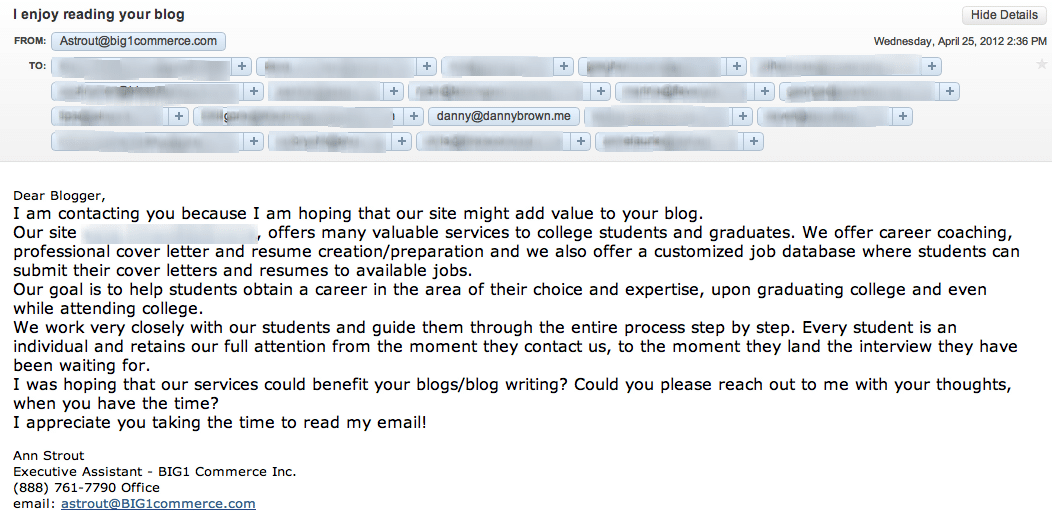
The email below arrived in my Inbox this afternoon (click to expand)

Email pitch

It was sent in the hope of garnering some press for the company’s website, that helps students connect with potential employers. Great – nothing wrong with that, and here’s to more companies helping students get a great start in life.

The problem is, the approach is all wrong and will probably put off every blogger they reached out to (and there were some big names in there). Here’s why:

  • The message header and the opening line don’t gel. The message header is great – “I enjoy reading your blog” is always an ego-stroke guarantee for a click-through. But then you get the generic “Dear Blogger” salutation. Bah.
  • Mass email, baby! As you can see, the email was sent to quite a few addresses and, better still, this was via open cc’d. This meant what should have (probably) been a private list now gave other people access to email addresses that the owner may not have want shared.
  • Lack of relevance. At no point in the email (apart from the standard opening blurb about being useful for the blog) is there a cohesive point made on why the company’s site would be relevant for my readers (or that of the other bloggers that were emailed).
  • A confidence-building domain… When I clicked through to the domain of the email sender, I was greeted with the image below.

Big1 domain

Now, it may be that the coolest website on the planet is due to arrive at the domain – who knows, even cooler than Chuck Norris! But for now, it raises alarm bells as to who’s behind the email and how well they’d serve the students they’re looking to help.

Simply put, it adds the finishing touches to an email that means well but does pretty much everything that goes against a solid blogger outreach program.

What They Could Have Done

Now, it may be that it’s a small company looking to get awareness and a foothold in the space, and they feel that bloggers with a certain audience reach can help. Or, they’ve heard blogging is the new advertising and it costs less money too.

Nothing wrong with that – most bloggers love to help promote something that’s relevant to their audience. The problem here is that the pitch fell flat at the first hurdle due to the approach.

What they could (should) have done is:

  • Ignore the mass email approach. Bloggers are generally busy people. If they feel a pitch isn’t truly targeted, they’ll ignore and move onto the next one. Try and really personalize the approach – use the blogger’s first name and a little overview of your understanding of the blog and audience. And, if you must use mass email, make it a BCC…
  • Use examples of relevance throughout. You don’t need to suck up to the blogger to get their attention, but maybe drop in 2-3 references to past posts that correlate to your service. Each reference builds your case – build the case and your job’s almost done.
  • Make sure you’re ready for investigation. Bloggers are successful because they’ve built trust with their audience. They won’t ruin that by not doing due diligence, and the first thing they’ll do is check you out. Make sure you’re ready for that – if your website isn’t built, don’t share your domain.

These are just really short suggestions based on this particular email and where it went wrong.?You also need a great boss who can educate you on best practices, just in case Ann is a junior and she’s been told to send a pitch like this. If so, her boss should be ashamed.

To really run a great blogger outreach program needs a very cohesive approach.?It also helps if you’ve been some part of the blogger’s audience beforehand – a tweet here, a blog comment there, etc.

Awareness of you means a better chance when it comes to sharing awareness of your product by the blogger in question.

Contrary to popular belief, bloggers do want to share your content – we just need a reason to do so.

Note: In his comment about this post, Frank Strong (who I respect immensely) questioned my outing of what may be a junior person at a PR agency. To clarify: this would never be a goal of mine.

If you try Google the name, nothing comes up. Nothing. Same with the company on LinkedIn. Which makes me think it’s a front for the “client” they’re pitching, which I did blur out.

Additionally, the blogger names that were on the email were all over the place. Two PR agencies; a sports blog; two tech blogs; a mobile phone blogger; a car forum and more. There was no rhyme or reason – it was just a blind pitch with a bunch of names thrown in for good measure.

With all that in mind, if someone is so indifferent that they don’t “exist” and are blasting out a generic message, then perhaps it makes no difference to blur or not.

The Clear and Continuing Need for Blogger Outreach Specialists at PR Agencies

Last week, I received an email pitch from a PR agency looking to feature their client on my blog. The pitch was friendly enough, but had one glaring error. Here’s the pitch:

Hi Danny,

Thanks to social giant Klout, Badgeville gamification customers can now associate a numeric score with social interactions.

Bottom line: companies will find it a whole lot easier to influence the behaviors of their customers.

Badgeville will leverage Klout?s influence-ranking technology to help enterprise leaders increase online engagement. The partnership will allow businesses to pinpoint which customer/employee carries the most influence and provide key analytics to score social influence.

I?d be more than happy to put you in touch with Badgeville and/or Klout to discuss what this means for social business. Please let me know if you are interested.

Thanks and Happy Friday!

Like I said, the pitch is friendly enough and offers a quick, punchy overview of why I might be interested, which is always a bonus. It sure as hell beats some of the pitches I receive!

But, as I also said, there’s one glaring error – the sender of the email clearly isn’t aware that there’s no chance in hell I’ll write about Klout in any way that promotes them.

As I’ve mentioned a few times, my opinion of Klout is that they’re unethical, they ignore user concerns, and?issue pat responses to criticism. Simply put, I think Klout is a joke.

Unfortunately, the fact I was sent the pitch demonstrates another example of how pitching needs to adapt, and PR agencies would do well to have either a blogger or someone that truly understands blogger outreach as a core promotional outlet versus just another?medium.

Bloggers Aren’t Special, Just Different

It used to be really easy to promote a client’s story. Grab some quotes, some images, meld into a news release, and send out to the wires. Newspapers and trade publications would run features, and clients would be happy with the exposure.

NB:?For my friend Gini, I know there’s a lot more to PR than news releases and publicity – I’m just using as an example here.

Then along came bloggers, and their taking over of the media as the perfect news channel. Since they weren’t (usually) limited by editorial, nor were they necessarily baised to brands or products, they offered a great alternative to traditional print media.

They also offered excellent SEO juice, as well as a captive and trusting audience in the blogger’s community of readers and subscribers. The problem was, the strengths and attraction of a blog were also its sore points, at least as far as PR agencies were concerned.

Because of the trust and non-bias bloggers could offer, they had to be approached differently.

Instead of blind pitching to a publication, where there were scores of journalists a pitch could be dispersed to, blogs are very often solo-driven. Sure, you have your Techcrunch’s and your Mashable’s but more often than not it’s individual bloggers with engaged communities that are approached.

And they need to be approached very differently.

Blogger Outreach – It’s Not That Hard, People

The difference in approach is exactly why you’ll hear good PR agencies (and marketers, and strategic advisors) talk about blogger outreach programs, and how they tailor their approaches and make sure the blogger is a fit for the client.

The reason for this is simple: a blogger’s key currency is their audience, and there’s no way a good blogger will ever risk that for a story that doesn’t fit and is clearly promotional.

If I suddenly started writing great things about Klout based on the pitch I received, my readers would call me out for double-standards, and rightly so. The same goes for any blogger, and emphasizes the point about the outreach hitting the right targets, which this one missed.

The thing is, blogger outreach is actually pretty easy – if you let it be:

Take the time to research the blogger.

Seriously. That’s all it takes. (Okay, it takes a wee bit more to build a great blogger program, and these six blogger outreach pointers from Monica O’Brien are great guidelines to help you with this.)

But as an example of knowing your target, all it would have taken was for the PR person that emailed me to use the search box in my sidebar, and type in Klout.

That would have shown my opinion of Klout and that I wouldn’t be interested, which?would save the agency time and negate the need to tell the client why they didn’t get editorial placement on certain blogs.

Because, ironically enough, bloggers (mostly) do?want to help PR agencies share their clients -?especially if it helps benefit their community and let the blogger share early news about an awesome and relevant product or service in their niche.

So, PR folks. It’s simple. If you don’t have a blogger outreach specialist as part of your make-up, it’s becoming increasingly important that you do.

Blogs aren’t going away any time fast – but your clients might if the coverage isn’t there because your outreach wasn’t researched…

image: bamalibrarylady

Social Media Marketing Success Doesn?t Have To Be A Hunt For A Four-Leaf Clover

Four Leaf Clover Social Media

Four Leaf Clover Social Media

This is a guest post by Stacey Acevero.

The rise of social media has created all sorts of new opportunities for small business marketers to get the word out, but it has presented challenges too.

The days of sending press releases to media outlets with the hopes of being lucky enough to get some coverage are long gone, morphing into constant opportunities to catch the next social media sharing phenomenon.

Today, it?s not enough to hit just those traditional media outlets.

You need to create a social media survival kit to help your business? content fly on Twitter, Facebook, YouTube and countless niche sites across the digital horizon.

Take heart, shareable content is not as rare (or hard to create) as you might think. With just a few tweaks, your content could be the talk of the sharing community.

Try these four tips to help make your press releases more social media friendly:

  1. Understand your audiences.?You?ve heard it before: make sure you are writing content geared toward your audience. Before you can write for them, you must understand who makes up that group. It?s more than just the specific prospects you are trying to appeal to; search engines are your readers too.?This is where search engine optimization comes in. Make your content highly rank-able with optimized keywords and phrases. The computerized audiences will love them ? but don?t forget that your primary readers are still human.
  1. Provide opportunities for sharing. Incorporate buttons that will allow readers to share on a number of networks. You may have thought of Facebook, Twitter and good-old-fashioned email, but you should also include sites such as:
  • Tumblr
  • StumbleUpon
  • Digg
  • Delicious
  • Reddit

Making your content easy and compelling to share is just one more way to motivate readers to spread your word.

  1. Tap into viral trends. All those videos, photographs and jingles floating across the web are making the rounds for a reason.?? Take a look at the top memes (virally spread ideas) and ask yourself, what can I do to make my content more playful, provocative or just plain different?

You may find that a simple video aimed at a niche site is the crux to a viral campaign that spreads to networks everywhere.

  1. Use your press release as a palette. Don?t think of your press release solely as a way to get out information. Put creativity into every element of your template by adding videos and photos to make the complete piece better positioned for social media marketing success.
  • Experiment with quirky or bold headlines
  • Use subtitles that ask questions or identify different takes on your topic
  • Use links, multimedia and photos to tell your story

Stay away from PR speaks; nobody has the time or interest to read it. Write like a storyteller and remember, there are millions of speed-readers on the net who skim content to determine readability.

Find a way to appeal to these scanners in an instant so they won?t just finish your press release, they?ll want to share it as well.

Think about the content you?ve been motivated to share. What about it drives you to let others in on the treasure you?ve found?

Translate that to your press release. If it?s important,? interesting and valuable, then with a few touch-ups you can make it eminently shareable too.

Shareable = Social Media Marketing Success!

So, your turn – how are you finding success in social media? Let’s hear your best practices below!

Stacey AceveroAbout the author:?Stacey Acevero is the social media community manager of PRWeb, where she engages the online community through PRWeb social channels such as Twitter, Facebook and LinkedIn daily with articles and conversation about PR, small businesses, SEO, social media and more. She is all about creative social media marketing ideas as well as building the PRWeb brand. Stacey also pens of some of PRWeb?s case studies. Connect with Stacey on Twitter at @SaceVero.?

  • « Go to Previous Page
  • Page 1
  • Page 2
  • Page 3
  • Page 4
  • Interim pages omitted …
  • Page 13
  • Go to Next Page »
© 2026 Danny Brown - Made with ♥ on Genesis