• Skip to primary navigation
  • Skip to main content
Danny Brown

Danny Brown

podcaster - author - creator

  • About
  • Podcasts
  • Journal

bad pr

Tipping the Scales

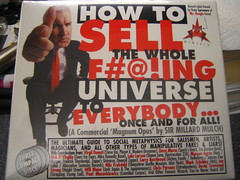
Sir Millard MulchSo there’s been plenty written about why bloggers hate PR people.

From lazy pitches to not knowing names and audience, there’s a veritable mish-mash of scorn poured on us PR nuisances from a lot of bloggers.

And, yes, some of it is warranted and trust me, I’m the first to call out bad PR practices.

But you know that just like anything, there’s always a flip side. Here’s an example.

I was speaking with a very good friend of mine who runs her own PR agency. She’s established a terrific reputation as one of the best PR people around and has deservedly won awards for her approach. Simply put, she’s a role model for great PR.

We were talking about the relationship between bloggers and PR and how we can improve it (“we” being both the blogosphere and the PR industry). This was when my friend shared one of her examples as to why that improvement might be further off than hoped.

She was working with a client whose core audience were “mommy bloggers”. The client’s product was ideally suited to the thousands of moms that have families of their own and blog about products in that niche. So, it would make sense for the PR campaign to connect with the blogging audience it’s suited to. So far, so good.

When my friend approached some of the key bloggers in this field, she had this response: “It’s $75 for a positive review, $100 if there’s an image attached.” When my friend queried this, she was told, “Get your client to splash the cash. If you’re getting paid, we want paid too.”

Say what?

Now, I understand about paid blogging and I have no qualms with it, as long as the blogger is upfront that it’s a sponsored post and that the review remains unbiased. Heck, we all need to make a living, but if you can’t offer full disclosure and non-bias then don’t take the money.

But this isn’t paid blogging – it’s simply a company asking (through their PR agency) if you’d be interested in product testing. You get first shot at the new line and you get to use and keep the product.

But you’re saying that if I pay $75, I’ll get a “positive review”? Isn’t this false advertising, or marketing, or whatever you wish to call it?

What happens if the product is crap? Will you still tell your readers that it’s great, because you’ve agreed to offer a positive review? How do you think your readers would feel about that? After all, aren’t they your most important audience?

Or is this just another point in your one-upmanship game with the PR industry?

Now, I’m not saying all bloggers (mommy or otherwise) are like this, either when it comes to product reviews or in the relationship they have with PR. I have some fantastic relationships with many bloggers and I couldn’t do a lot of my work without them.

But to those bloggers that my friend had the misfortune of dealing with?

A blog is your personal voice. Your readers are your community. Is both your voice and community something you’d happily sell down the river for a few bucks?

Because if they are, then that’s the real bad PR.

Creative Commons License photo credit: rick

Melrose Jewelers, Rolex and Owen Wilson ? The Sequel

Faces of DenialBefore I start this post, I just want to apologize in advance if it gets a little lengthy – it’s my response to a Cease and Desist letter I received last week.

Recently, I wrote about Melrose Jewelers and a press release they had issued. The release discussed actor Owen Wilson’s suicide attempt and said that his Rolex watch had played a major part in the actor being alive today.

At the time, I personally found the release to be crass and in poor taste – it smacked of taking advantage of someone’s personal problems for gain (in this case, to sell more watches by Melrose Jewelers).

The comments in the post seemed to agree, as did numerous other views of the same press release. To get you up to speed, I’ll wait while you read the post, if that’s okay.

Last week, I received a Cease and Desist letter from the Law Offices of Peter D. Cole, who is based in Los Angeles and represents Melrose Jewelers. The letter made a number of claims against my post and requested that I remove it. Failure to do so would result in Melrose Jewelers “pursuing other alternatives to mitigate any damages”.

To save time, I’ve scanned the attorney’s letter and transferred it to a PDF file, which you can read here. Again, I’ll wait until you’ve read it so you can compare it to the post in question, if you like. The letter is “as is” – there is no letterhead or registered business numbers on it (which I had to request from Peter D. Cole for clarification). I’ll let you read the letter before continuing.

The attorney for Melrose Jewelers is ultimately saying that I’m causing his client loss of business; that my post is “inciteful rhetoric”; that I’m associated with another Internet watch sales business; and that I wasn’t stating facts. I find that a slight on my character and transparency. Additionally, the request to Cease and Desist under threat of further legal action is never pleasant.

Therefore, obviously, I felt a need to respond. This is it (taken from my emailed response to Peter D. Cole today, and with Cole’s points in bold).

Hi there Peter,

Thanks for you response, appreciate it.

With regards your client’s “claims”, I would respond with the following:

1. “You had conversations with unnamed Rolex executives, to incite Rolex to take actions and/or make comments about my client’s advertising.” There is nothing in the comments that says this. I mentioned I was, and I quote, “speaking to someone today about Rolex’s awareness. He’s in the jewelry industry and was at a big meeting last night where the CEO of Rolex was also attending.” That’s a big difference from knowing Rolex executives. FYI, the person I was speaking to is a director of a pearl company – quite the different market from your client.

2. “…If you yourself are somehow associated with an Internet watch sales business, as my client is informed and believes”. As I mentioned, my “relationship” is with a pearl company – hardly a competitor. Your client’s statement also seems bizarre. I’m guessing if he knows someone that owns a fast food restaurant, he can’t say that he doesn’t like McDonald’s, as that would be seen as “unfair business practices”?

3. “You describe my client as little more than a second hand watch shop”. By your own words, you say that people who “cannot afford to purchase them new, to obtain them pre-owned at a significant discount in price”. So, they’re not new? Which makes them second-hand.

My whole post was about whether or not the press release was crass (by taking advantage of someone’s personal situation for gain), as well as the editorial process that allowed it to be published. The comments that followed from my readers bore this out. Additionally, there are many more sites and blogs that offer a far more disparaging account of your client’s release than I do.

My post was not to “incite Rolex to take actions” – more, it was to question what passes as acceptable PR and why it’s important for brands to be aware of what’s being said in the name of their company.

I have some questions for your client. Did Rolex authorize this release? Did Owen Wilson authorize this release? Can it be factually proven that Owen Wilson’s watch turned him back from the precipice of despair?

Unless your client can answer “Yes” categorically to these questions, then the release (and the original blog post it stemmed from) are merely opinion, and not fact. Something which separates a news release from an opinion piece. Which is exactly what my blog referred to.

Therefore, I will be leaving the post as is.

Best,

Danny.

There are a lot of things wrong with the PR industry. There are a lot of things good about it as well. Like any industry, there are good people and not-so-good people.

One thing that is apparent is that releases like the ones Melrose Jewelers issued don’t help to repair the view that PR professionals are uncaring and will say anything for a fast buck. If there is no concrete proof that Owen Wilson’s watch helped him during some dark times, then saying that it did suggests sensationalism in order to sell more watches.

In my original post, I shared my view of that, and of using PR in this way. I also asked the question what it would do for a company’s reputation that was happy to use PR in this way.

The Cease and Desist letter from Melrose Jewelers gives me their answer. I feel it’s only fair to offer them mine. Which is why the original post will remain.

Thanks for reading. I’d be interested in your take. Is there more than PR and brand awareness being questioned here?

Creative Commons License photo credit: narek781

When Does Embellishing End and Lying Begin?

How to Know when Someone's Lying
Image by ATENCION: via Flickr

Let me ask you a question – what’s your view of the PR industry? It doesn’t matter if you’re involved in it professionally, someone that uses its services or just an average person on the street – is it a positive or negative view?

I’m guessing that the majority of views about the industry I love and work in are fairly negative. There’s the belief that we’re charlatans who are just after a client’s money, we don’t tell the truth and we have an over-inflated opinion of ourselves.

Sadly, all of that and more is true of some of the “professionals” in the PR industry.

Yet for every one bad egg, I can pretty safely say that there are many more good and ethical PR professionals who are trying desperately to rid the industry of the individuals who give it a bad name.

By working differently; having our practices transparent and open for anyone to see; and encouraging the new breed of PR professionals and interns coming through to have more say in our industry. It’s a slow process, but it is happening.

Which is why this press release from Melrose Jeweler’s disgusts me so much.

According to the release, Hollywood actor Owen Wilson was contemplating suicide until he realized that the quality of his own life must be good because of the quality of his Rolex watch. That’s right – his watch proved to him the value of his life.

What. The. F**k?!?

Now, I don’t know how serious Owen Wilson’s issues are, or his state of mind – I’ve never been a big follower of celebrity news. But whatever his problems (or anyone else that feels so desperate in their situation that they consider taking their own life), I’m pretty sure a piece of jewelry isn’t going to mean a whole lot to them, no matter how luxurious.

At first, I (like many others) thought that the blame for the morally-lacking release laid at Rolex’s feet. But when you actually take a little time to look into the story and the background of it, you realize that it originates from the blog of Melrose Jewelers. Dig a little further still, and you see that Melrose Jewelers are only selling pre-owned Rolex watches – which kind of makes them little more than a second-hand watch shop.

Taking all that into context, and the sheer crassness of the blog post and subsequent press release, I wonder if Rolex are even aware of the statements being made by Melrose Jewelers on behalf of their brand? Since the original blog post was published on December 15 2008, and I can’t find any rebuttal online from Rolex, it looks like they’re not aware of the release. Which then has me asking more questions:

  • If one of the most well-known companies in the world for luxury watches isn’t aware of something as bad as this story, what does it say about their brand monitoring strategy?
  • Are the owners of Melrose Jewelers so insensitive they’ll resort to measures such as using someone’s suffering to try and boost profits? Didn’t they learn anything from the Back-Up Shotgun Rack fiasco?
  • Does the editorial process of newswire sites need looking at if they think this kind of release is acceptable? Or are our morals no longer part of approval?

There’s a lot wrong with this story and I’m sure there’s a lot more to come, particularly if Rolex is still to find out about it. (And I’m hoping that’s the case and that they’re not part of the whole mess). On early viewing, it does look like it’s a horrible PR stunt taking advantage of someone’s suffering and that only helps confirm people’s negative views of the industry.

Looking at it more, though, it’s clear that it’s the jeweler that’s at fault – even the media contact on the press release is a “Mike D.” from the Melrose sales team. Which makes me question whether there was any PR guidance given at all – personally, I doubt it. No PR professional – no good one, that is – would have touched this with a barge pole. Additionally, there are no direct quotes from either Rolex or Owen Wilson – another sign that the press release lacks any authoritative backing.

Lessons learned? Know how your brand is being represented online. Monitor your name at all times. Your reputation depends on it, and that’s your most valuable asset.

As for Melrose Jewelers? I ask you this – what do you think this does for your reputation?

  • Update. Following this post, I received a Cease and Desist letter from an attorney representing Melrose Jewelers. You can read all about it and my response here.

When to Blame the Agency and When to Blame the Client

The recent online outcry about the Motrin advert has shown just how powerful a tool social media can be. For anyone who hasn’t heard the story, it’s about the pharmaceutical company upsetting mothers everywhere with an advert that was deemed condescending by the very mothers the company was targeting. You can read more about it here.

It comes after the furore over the poorly thought out press release issued by the BackUp Shotgun Rack company that took advantage of the Jennifer Hudson tragedy. These two events and others like them make it clear that some companies are still not getting the power of social media. Get something wrong online and boy you better be prepared for the backlash.

In Motrin’s case, the company has removed the ad from their website, although there are other versions that have made it to print so the damage could be long-running. In the BackUp example, the jury is still out on whether lessons have been learned.

Yet it’s also obvious in both cases that there have been some major lapses of co-ordinated and cohesive thinking. But who’s to blame for this – the agency that came up with these ideas, or the client that offered final approval?

Going by some of the comments doing the rounds on Twitter and the blogosphere, much of the thinking seems to be aimed at the marketing or advertising agency responsible for the Motrin campaign. After all, they’re the ones that came up with the idea in the first place, right?

So where does the final responsibility stand? Is it with the agency or the client? Someone must have approved the advert to go out, and that wouldn’t have been a decision that lay with the agency in question. It would have been one of the main decision-makers at Motrin.

And therein lies the quandary. Does the final decision really lie with the client? If I’m a pharmaceutical business owner that employs a marketing, PR or advertising agency to run a campaign for me, it’s because I trust them to do a job that I know nothing about. I’ll stick to making pills because that’s what I know. You’re my agency, you’re my specialist – you guide me.

But is that really true? I’m not so sure. Speaking from personal experience, when I’m putting together a PR campaign for a client, I’m there right up until the final decision. At that stage, I’ve offered all my recommendations, all my strategies and subsequent follow-ups. Now it’s up to my client to decide how he or she wants to move forward.

After all, this is their company that’s going to be out in the firing line if things go wrong, so they need to be 100% sure they’re happy with what they’re doing, and have the confidence to see it through. If they have any qualms at all, they don’t go ahead with the suggestions and we either start again or go our separate ways.

It’s a tough one to call. Company decision or agency recommendation.

What do you think? Should Motrin or businesses in the same situation be the ones that take responsibility? Or is it an agency problem?

If you enjoyed this post, please consider leaving a comment and subscribe to my RSS feed or via email to ensure you can enjoy the latest post(s).

  • « Go to Previous Page
  • Page 1
  • Page 2
© 2026 Danny Brown - Made with ♥ on Genesis