
• Skip to primary navigation
  • Skip to main content
Danny Brown

Danny Brown

podcaster - author - creator

  • About
  • Podcasts
  • Journal

blogger outreach

Don’t Be the Company Sending a Crappy Email Pitch That’s Breaking the Law

Ignorance

Ignorance

Back in 2003, President George W. Bush passed the CAN-SPAM (Controlling the Assault of Non-Solicited Pornography and Marketing) Act, that was meant to establish standards when it came to commercial email and help protect consumers from errant businesses filling email inboxes with their crud.

While well-intentioned in its creation, unfortunately its been much less effective when it comes to actually making marketers and promotional companies any better at respecting the wishes of those they seek to target.

This, despite specific instructions as to what can and can’t be done by these marketers:

  • There must be a visible and operable unsubscribe mechanism present in all emails;
  • A message can’t be sent without an UnSubscribe option;
  • A message cannot be sent to a harvested email address;
  • A message should contain at least one sentence.

There are many more do’s and don’ts attached to the CAN-SPAM Act, but for this post, I’m highlighting these four in particular, since it’s clear Haworth Marketing + Media don’t really care about them.

Poor Pitch or Ignorance of CAN-SPAM?

I received this email from Haworth yesterday (click image below to expand).

Haworth email pitch

I’ve blurred out the name of the person sending, as it appears they’re in a more junior role and have been tasked with sending out this pitch by an account manager or more senior person.

As you can see, it ignores all the points of the CAN-SPAM Act I referenced: there’s no unsubscribe option, I don’t recall ever signing up for updates from Haworth, and there’s no sentence – not even a single one – within the email body itself.

Instead, as you can see by the red highlighted box, there’s an attachment that I’m meant to trust, download and open – all from a source I don’t know and have never asked to know (to the best of my recollection).

Quite the winning pitch…

It Doesn’t Need to be This Way

The fact that Haworth sent this out like this is disappointing enough. It shows a lack of understanding of what makes a good blogger outreach program. It’s not as if there aren’t enough reference points, either.

Posts like this, or this, or this, or this, or this, or… you get the picture. And that’s just on this blog.

There are countless other posts, articles, and more, on what makes a blogger outreach campaign work. Just Google “blogger outreach tips” and you’ll get around a million results, with excellent advice to be found here, here, here and here, just for starters.

Haworth themselves claim to understand what makes a promotional campaign work. In their own words:

Our differentiation comes from changing the conversation in media; through inspired media design and thoughtful collaboration with communication partners, we generate impactful, lasting impressions that translate into deep, emotional connections.

Having said that, when you dig a little more into their site and look at their client services, they don’t offer blogger outreach as part of their solutions. They do offer content marketing, but not blogger outreach specifically – so perhaps the email approach I received shouldn’t be a surprise after all.

Which is a shame. Bloggers are an increasingly important part of any online marketing or promotional component for today’s brands – just ask Martha Stewart about that point.

Educate Yourself Now or Be Left Behind

As shared throughout this post, there are a ton of resources around to ensure you craft the right type of approach for your campaign – one that will bring a better result than being criticized by the person you’re trying to engage with.

  • Respect the CAN-SPAM Act in its entirety (I requested removal from Haworth’s list after a previously dubious email, to no avail);
  • Don’t send attachments without prior acceptance and a description of what the attachment is;
  • Don’t fob off your email blasts to a junior employee, thus relieving yourself of any responsibility when called out;
  • Educate your marketing/promotional staff on company expectations (hint: these shouldn’t be the example used for this post);
  • Read publications and blogs that speak of this increasingly important outreach outlet, and understand the nuances it needs.

Yes, it will be a pain to make the switch and, yes, it might even mean you refocusing on areas you had been loosely paying attention to before.

But, as “old media” – traditional ads, TV and radio spend, etc – begin to see their effectiveness eaten up by newer media, particularly by bloggers with a relevant audience, taking the approach of sending out a blast email with nothing but an attachment is just a poor promotional decision.

Especially when it’s effectively breaking the law…

image: Max Bisschop

The Best Practice Guide for Blogger Outreach

best practices blogger outreach

Best practices for blogger outreachIf you’re a regular reader here, you’ll know one of my pet peeves is the (more often than not) crappy pitches that PR agencies and consultants send to bloggers.
It’s almost like there’s a bulletin board somewhere that says if you have a campaign or product to launch, and you want bloggers to write about you, you treat them like idiots.

You can send pitches that make absolutely no sense, or you can make it completely impersonal and almost meat-market in approach.

Of course, there are always great examples of how to do a blogger outreach well, and how to really engage a blogger in a way that truly encourages engagement and appreciation from the blogger.

Sadly, the good ones still seem to be outnumbered by the bad ones.

Which is why Forth Metrics’ new ebook, The Best Practice Guide for Blogger Outreach is such a well-timed and much-needed read.

Compiling best practices and examples of how PR and bloggers can get along better with each other, this ebook is literally the blueprint for all PR practitioners to follow if they want to successfully connect with a blogger and his or her audience.

It includes words of wisdom from the likes of respected professionals Shelly Kramer, Paul Sutton, Gini Dietrich, Tonia Ries and many more, all of whom understand the core principals of successful blogger outreach and relations.

Oh, and it includes some Scotsman as well, if that floats your boat…

The ebook includes:

  • How to set objectives for an outreach campaign
  • How to research a campaign properly
  • How to develop relationships with bloggers
  • How to approach a blogger and what you can offer them
  • How to optimise your approach
  • How to track and measure your performance
  • How to keep a ?win-win? relationship going
  • All supplemented with loads of tools and resources

It’s available for free, and really is your primer for your next blogger outreach campaign – and will probably stop curmudgeons like me writing about your latest bad pitch. Who can argue with that?

Get your copy by clicking the image below.

best practices blogger outreach

If You Want to Pitch A Blogger Successfully, DON’T Do This

Email pitch

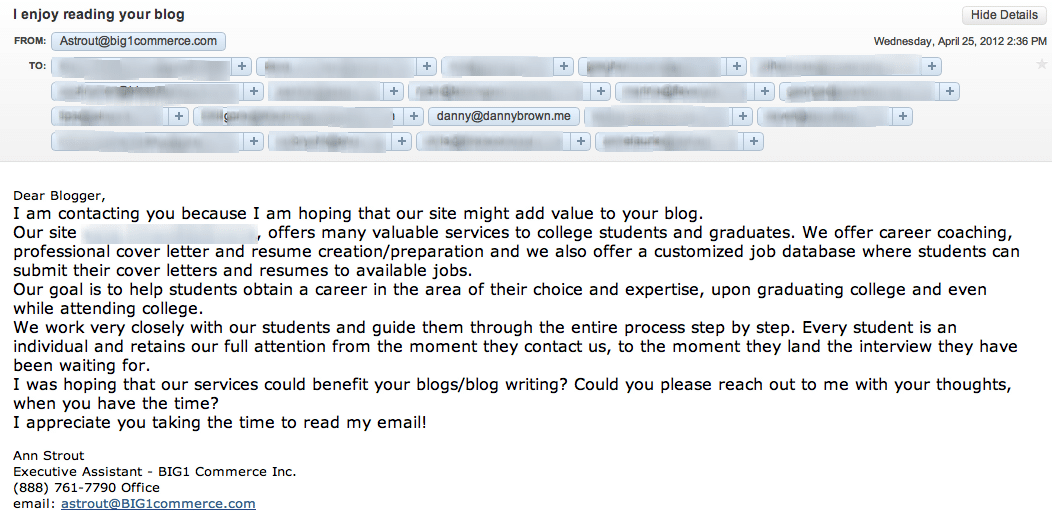
The email below arrived in my Inbox this afternoon (click to expand)

Email pitch

It was sent in the hope of garnering some press for the company’s website, that helps students connect with potential employers. Great – nothing wrong with that, and here’s to more companies helping students get a great start in life.

The problem is, the approach is all wrong and will probably put off every blogger they reached out to (and there were some big names in there). Here’s why:

  • The message header and the opening line don’t gel. The message header is great – “I enjoy reading your blog” is always an ego-stroke guarantee for a click-through. But then you get the generic “Dear Blogger” salutation. Bah.
  • Mass email, baby! As you can see, the email was sent to quite a few addresses and, better still, this was via open cc’d. This meant what should have (probably) been a private list now gave other people access to email addresses that the owner may not have want shared.
  • Lack of relevance. At no point in the email (apart from the standard opening blurb about being useful for the blog) is there a cohesive point made on why the company’s site would be relevant for my readers (or that of the other bloggers that were emailed).
  • A confidence-building domain… When I clicked through to the domain of the email sender, I was greeted with the image below.

Big1 domain

Now, it may be that the coolest website on the planet is due to arrive at the domain – who knows, even cooler than Chuck Norris! But for now, it raises alarm bells as to who’s behind the email and how well they’d serve the students they’re looking to help.

Simply put, it adds the finishing touches to an email that means well but does pretty much everything that goes against a solid blogger outreach program.

What They Could Have Done

Now, it may be that it’s a small company looking to get awareness and a foothold in the space, and they feel that bloggers with a certain audience reach can help. Or, they’ve heard blogging is the new advertising and it costs less money too.

Nothing wrong with that – most bloggers love to help promote something that’s relevant to their audience. The problem here is that the pitch fell flat at the first hurdle due to the approach.

What they could (should) have done is:

  • Ignore the mass email approach. Bloggers are generally busy people. If they feel a pitch isn’t truly targeted, they’ll ignore and move onto the next one. Try and really personalize the approach – use the blogger’s first name and a little overview of your understanding of the blog and audience. And, if you must use mass email, make it a BCC…
  • Use examples of relevance throughout. You don’t need to suck up to the blogger to get their attention, but maybe drop in 2-3 references to past posts that correlate to your service. Each reference builds your case – build the case and your job’s almost done.
  • Make sure you’re ready for investigation. Bloggers are successful because they’ve built trust with their audience. They won’t ruin that by not doing due diligence, and the first thing they’ll do is check you out. Make sure you’re ready for that – if your website isn’t built, don’t share your domain.

These are just really short suggestions based on this particular email and where it went wrong.?You also need a great boss who can educate you on best practices, just in case Ann is a junior and she’s been told to send a pitch like this. If so, her boss should be ashamed.

To really run a great blogger outreach program needs a very cohesive approach.?It also helps if you’ve been some part of the blogger’s audience beforehand – a tweet here, a blog comment there, etc.

Awareness of you means a better chance when it comes to sharing awareness of your product by the blogger in question.

Contrary to popular belief, bloggers do want to share your content – we just need a reason to do so.

Note: In his comment about this post, Frank Strong (who I respect immensely) questioned my outing of what may be a junior person at a PR agency. To clarify: this would never be a goal of mine.

If you try Google the name, nothing comes up. Nothing. Same with the company on LinkedIn. Which makes me think it’s a front for the “client” they’re pitching, which I did blur out.

Additionally, the blogger names that were on the email were all over the place. Two PR agencies; a sports blog; two tech blogs; a mobile phone blogger; a car forum and more. There was no rhyme or reason – it was just a blind pitch with a bunch of names thrown in for good measure.

With all that in mind, if someone is so indifferent that they don’t “exist” and are blasting out a generic message, then perhaps it makes no difference to blur or not.

The Clear and Continuing Need for Blogger Outreach Specialists at PR Agencies

Last week, I received an email pitch from a PR agency looking to feature their client on my blog. The pitch was friendly enough, but had one glaring error. Here’s the pitch:

Hi Danny,

Thanks to social giant Klout, Badgeville gamification customers can now associate a numeric score with social interactions.

Bottom line: companies will find it a whole lot easier to influence the behaviors of their customers.

Badgeville will leverage Klout?s influence-ranking technology to help enterprise leaders increase online engagement. The partnership will allow businesses to pinpoint which customer/employee carries the most influence and provide key analytics to score social influence.

I?d be more than happy to put you in touch with Badgeville and/or Klout to discuss what this means for social business. Please let me know if you are interested.

Thanks and Happy Friday!

Like I said, the pitch is friendly enough and offers a quick, punchy overview of why I might be interested, which is always a bonus. It sure as hell beats some of the pitches I receive!

But, as I also said, there’s one glaring error – the sender of the email clearly isn’t aware that there’s no chance in hell I’ll write about Klout in any way that promotes them.

As I’ve mentioned a few times, my opinion of Klout is that they’re unethical, they ignore user concerns, and?issue pat responses to criticism. Simply put, I think Klout is a joke.

Unfortunately, the fact I was sent the pitch demonstrates another example of how pitching needs to adapt, and PR agencies would do well to have either a blogger or someone that truly understands blogger outreach as a core promotional outlet versus just another?medium.

Bloggers Aren’t Special, Just Different

It used to be really easy to promote a client’s story. Grab some quotes, some images, meld into a news release, and send out to the wires. Newspapers and trade publications would run features, and clients would be happy with the exposure.

NB:?For my friend Gini, I know there’s a lot more to PR than news releases and publicity – I’m just using as an example here.

Then along came bloggers, and their taking over of the media as the perfect news channel. Since they weren’t (usually) limited by editorial, nor were they necessarily baised to brands or products, they offered a great alternative to traditional print media.

They also offered excellent SEO juice, as well as a captive and trusting audience in the blogger’s community of readers and subscribers. The problem was, the strengths and attraction of a blog were also its sore points, at least as far as PR agencies were concerned.

Because of the trust and non-bias bloggers could offer, they had to be approached differently.

Instead of blind pitching to a publication, where there were scores of journalists a pitch could be dispersed to, blogs are very often solo-driven. Sure, you have your Techcrunch’s and your Mashable’s but more often than not it’s individual bloggers with engaged communities that are approached.

And they need to be approached very differently.

Blogger Outreach – It’s Not That Hard, People

The difference in approach is exactly why you’ll hear good PR agencies (and marketers, and strategic advisors) talk about blogger outreach programs, and how they tailor their approaches and make sure the blogger is a fit for the client.

The reason for this is simple: a blogger’s key currency is their audience, and there’s no way a good blogger will ever risk that for a story that doesn’t fit and is clearly promotional.

If I suddenly started writing great things about Klout based on the pitch I received, my readers would call me out for double-standards, and rightly so. The same goes for any blogger, and emphasizes the point about the outreach hitting the right targets, which this one missed.

The thing is, blogger outreach is actually pretty easy – if you let it be:

Take the time to research the blogger.

Seriously. That’s all it takes. (Okay, it takes a wee bit more to build a great blogger program, and these six blogger outreach pointers from Monica O’Brien are great guidelines to help you with this.)

But as an example of knowing your target, all it would have taken was for the PR person that emailed me to use the search box in my sidebar, and type in Klout.

That would have shown my opinion of Klout and that I wouldn’t be interested, which?would save the agency time and negate the need to tell the client why they didn’t get editorial placement on certain blogs.

Because, ironically enough, bloggers (mostly) do?want to help PR agencies share their clients -?especially if it helps benefit their community and let the blogger share early news about an awesome and relevant product or service in their niche.

So, PR folks. It’s simple. If you don’t have a blogger outreach specialist as part of your make-up, it’s becoming increasingly important that you do.

Blogs aren’t going away any time fast – but your clients might if the coverage isn’t there because your outreach wasn’t researched…

image: bamalibrarylady

How PR and Bloggers Can Help Each Other

We could have been like thisThere’s been a lot of talk about the relationship between the public relations industry and bloggers. I’ve written about it in the past as have others, yet still there’s this feeling of a barrier between the two mediums.

As someone on both sides of the fence, I can understand each side’s views.

Yet I can also see where both sides could improve. So, with no bias to either the PR industry or bloggers, here are some suggestions to help both PR and bloggers help each other.

PR People – Think Like Bloggers

Consider starting a blog if you don’t already have one. Unless you blog yourself, you probably won’t understand the mindset of a blogger. It can be a lonely and time-consuming business – the last thing we want is added workloads through misunderstanding or laziness. If you blog, you’ll have a better appreciation of how we work and how our time can best be used.

Treat us as a bona-fide media source in both your pitching and follow-ups. True, we may not have the name of a New York Times or CBS journalist or reporter. But we often are more visible, thanks to Google and search engine awareness, which means our story could potentially have a much wider audience. Doesn’t that deserve some respect?

Find out who we are and what we do. You have a gardening tool to promote for a client. So why would you send your news release to a tech or music blogger? Don’t just grab a bunch of names from a blogger list – do a little homework, find out what we write about, our style, etc. Trust me, show me you know about me and my readers and you’re almost home dry with me.

Invite us to participate in what your clients are up to. Bloggers love to be involved early on – after doing your homework on who would fit you client base, invite bloggers into your inner circle as your official blog partners. Let us tell your story (without any major interference) and you’ll have a primed marketing team of bloggers ready to go.

Bloggers – PR is Not Your Enemy

Bloggers are wary of PR people. Lazy pitches, poor communication and being treated as second-class citizens are just some of the complaints. Yet there are ways to help yourself be more appreciated by the PR industry.

Have either an About Me page or an area that describes what your blog is about. This may seem like common sense but the amount of reviewer blogs I’ve seen without this simple addition is mind-boggling. How can you expect a proper pitch when you don’t advise on what you write about?

Display a PR-friendly badge to let us know that you’re open to pitching. Todd Defren and the folks over at Shift Communications have come up with some badge designs you can use. Clean and clear, they save both PR people and bloggers a lot of time.

Be ethical at all times and true to your beliefs. This works both ways. Your blog is your voice and your readers should trust that voice. Keep your views honest and untainted by PR pressure. And if someone in PR is pressuring you into a positive spin when their client doesn’t deserve one, don’t be afraid to call them out via your blog.

Contact us and offer your services as part of a PR agency’s blogger outreach program. Many PR firms and professionals are still far behind on the benefits of a blogger outreach program. Use Google, Twitter, O’Dwyer’s blog and other resources to find agencies in your niche. Then send them an email about your expertise and how they could benefit from it. Pro-activity never hurt anyone.

These are just some examples of how the PR industry and bloggers can help each other. I’m sure there are countless more, but it’s a start.

How about you? Are you a blogger? If so, how can PR professionals improve? Or are you in the PR industry? Where would you like to see bloggers improve? Feel free to share your views and let’s get the conversation going.

Creative Commons License photo credit:?lepiaf.geo

© 2026 Danny Brown - Made with ♥ on Genesis