• Skip to primary navigation
  • Skip to main content
Danny Brown

Danny Brown

podcaster - author - creator

  • About
  • Podcasts
  • Journal

brands

Brands and Marketers Won’t Ruin Social Media – Consumers Will

There’s a popular saying that marketers ruin everything. As a marketer, I agree and disagree.

Yes, crappy marketing by brands, or crappy marketers in general, ruin social media. Yet that’s been true of any crappy marketing, and it’s not restricted to social media.

Let’s face it, crappy anything ruins something.

  • A crappy experience with a customer service adviser who’s having a bad day can ruin your perception of a brand;
  • A crappy meal can ruin your special evening;
  • A crappy update of your favourite movie series can ruin your fond memories of what came before (I’m looking at you, George Lucas!!!).

But for some reason, marketers and brands are coming in for special attention recently, with many articles across the web decrying how social media has been ruined by brands and marketers.

For me, though, it’s not marketers of brands who have ruined social media – it’s consumers. Specifically, consumers who say they want brands to be a certain way on social media, but their [consumer] actions don’t back that up.

Why Are Marketers Being Blamed for Social Media’s Descent?

As I mentioned at the start of this post, the belief that marketers ruin everything, especially social media, is pretty popular and widespread. Run a search on Google for the term “marketers ruined social media” and you’ll get almost half a million results.

Some of the posts and articles include titles like How Marketers Ruined Social Media, What It Takes to Succeed at Social Media, Is Marketing Ruining Social Media?, and Don’t Pee in the Pool: How Digital Marketers are Ruining Social Media.

Spot any recurring themes there?

In addition to these posts, my friend and co-author on Influence Marketing, Sam Fiorella, published an interesting post the other day titled Social Media Has Killed Consumer Trust.

Sam uses graphs from Student Monitor that shares how US college students make decisions. The most trusted resource was still friends and word-of-mouth, with “information on the Internet” coming in at less than half the word-of-mouth percentage.

Influence-Marketing-Social-Media-Trust-Millenials

The takeaway was that social media, because of brands and marketers and their method of sponsored content, placing importance on numbers of followers, and using fake influence scores to determine authority, has been ruined by lazy marketing and poorly implemented tactics.

And on that, I agree. But do the actions of lazy marketers (and I use that term loosely when speaking about some of these “professionals”), who put more emphasis on quick hit, low return campaigns speak for all of marketing and brand engagement strategies?

No.

[clickToTweet tweet=”It’s not just lazy marketing to blame for social media’s fall from grace – it’s also consumers.” quote=”Much like you wouldn’t blame the dog for the stink coming from the cat litter box, don’t blame the wrong people for social media’s perceived downfall.”]

But it’s not just lazy marketing that’s to blame for social media’s so-called fall from grace – it’s consumers, and the demand for more personal and human interactions, and then crucifying the brands that do this.

Be Human, Except Don’t Be

One of the reasons social media was seen as turning point in the relationship between consumers and brands was that it finally allowed us, as consumers, to have a one-to-one conversation (or as close as) with the brands we do business with.

Yet, much like anything that affords people extra power, this can be (and is) abused. For example,

  • In 2009, I wrote about Doug Meacham, a consultant with IBM, and his hounding of the CMO of Best Buy regarding the price difference between offline and online sales. Doug was like an angry dog chasing a bone, and was the first time I’d seen the “power” of consumer-led abuse in action on social.
  • In 2010, when an 8 year old boy dying from muscular dystrophy and traveling on Air Canada had his custom wheelchair damaged by the airline,?Twitter lit up, led by a Canadian social media power player. Air Canada came in for massive abuse, and it seemed justifiably so – until you learned that Air Canada immediately sent the chair for repair when they saw its damage. Because the chair was custom-made, it couldn’t be repaired as fast as a normal chair, so they provided a manual chair (replaced the same evening with an electric one), while they tried to get the customized one repaired as fast as possible. Yet this wasn’t widely shared on social – go figure.
  • In 2011, social media guy CC Chapman went after Ragu in not just one blog post, but three, each one escalating a little more, because Ragu had reached out to Chapman about a new campaign they were doing involving dads, and Chapman took offense to the approach.

These are three early examples of consumers not only reacting to brands and their faux pas, but reacting in a way that essentially placed the brand in a no-win situation (just ask GAP when they crowdsourced a new logo on social media, and the response they got, for another one).

What each one does is show while consumers (even marketers are consumers away from the “day job”) want brands to be on social and be receptive, it’s actually more about being on social and on the consumer’s terms.

Does that sound like the kind of two-way interaction/relationship that social media was originally lauded for?

We All Need to Be Responsibly “Social”

Of course, times change. While social media may have been celebrated for its ability to connect consumers with brands, and vice versa, that relationship goal (or the perception of a relationship) has changed.

Eager to avoid a “social media fail” like the 89 million results a search for the term results in, brands lost their voices, and subsequently acquiesced to any and every little bit of criticism online. Even when brands were in the right, they’d apologize and advise they’d try do better.

[clickToTweet tweet=”We say we want brands to be more human on social media. Then we destroy them for trying.” quote=”The only thing to fear is fear itself. That, and being a brand on social media when the cards have been stacked against you before you even sit down at the table.”]

Sensing this, consumers have become more vocal, and even when they’re in the wrong, the groupthink mentality kicks in and the social media consumer “wins” pretty much every time.

When this happens, we all lose. Brands pull back from social, and the research and intelligence that can be gathered to improve the customer experience is lost.

While we, as consumers might celebrate the fact our publicly available data and updates aren’t being mined by brands, is it actually a victory? If it means crappy marketing strategies and questionable approaches to privacy are concerned, yes, it is.

But if a brand is answering queries on social media, and the consumer still craps on them for daring to provide the right answer, is it really the brand at fault?

Is it really the marketer who’s at fault for tailoring ads, offers and campaigns that a consumer has specifically said they want, and then that same consumer complains about seeing the promotion in their social feed?

Like I said earlier, it’s become a no-win situation for both brands and marketers on social, even when they’re doing things the way consumers say they want things to be done.

Ironically, perhaps the lazy marketers have got it right. After all, if brands spend a sizeable amount of money and personalized approaches to please the consumer, and still get beaten down for it, why bother? Why not just spray and pray like the crappy marketers have been doing for years?

Why indeed.

If we really want social to be the place it can be, we need to stop crapping on brands that try to do it right. Otherwise, it won’t be marketers and brands that ruin social media – it’ll be us, the consumer, by turning it solely into a soapbox for the loud and brash bully.

And that never works out well for anyone…

Speed of Resolution Over Speed of Response is Key to Social Media Success

Speed

For a lot of consumers, companies that can respond within minutes on the social sphere send out a far more positive message than those that dilly-dally.

But does this type of instant response really benefit us, both as customers and brands? While this speed might be something that would always exist in an ideal world, unfortunately we don’t live in an ideal world.

Not only that, but by setting these expectations, we’re also?setting companies up?to fail by jumping to action as soon as their name is mentioned.

It’s why, instead of the speed of response,?it’s speed of resolution that should really define how successful a company is in social media (or any other business medium).

The Problem With Speed of Response

In an ideal world, we (as consumers) would have answers to our questions almost as soon as we’ve asked them. If we have a problem with a product, it’ll be resolved immediately.

Or we have a complaint – it’ll be heard and acted upon quicker than you can say, “Sorry, sir/miss/madam, we’ll get onto that right away.”

But the desire for that kind of brand interaction?falls short of the realistic one, for several reasons.

Legal red tape

You’d think that a simple, “We’re sorry you feel that way, and we’ll look into this for you” would suffice as an acceptable way to cover a customer issue. And it should be.

The problem is, if it’s an issue that involves legal counsel, everything has to be approved. Everything. Even a simple “We hear you”.

Because if a multi-million dollar lawsuit is the potential outcome (especially involving a pharmaceutical company, for example), then the?company better make damn sure everything is documented and carried out to the letter of the law.

Locale and culture differences

Say you’re a consumer in Canada, but the main team you need to speak to is in China. So there’s a time difference to start with. There are also different cultural holidays; so response times are immediately affected.

The issue of scale

Sure, we’d all like to think our companies?(either own, employed or those we buy from) are the biggest on the market, so we should expect a 24/7 every-minute-of-the-day personalization level. But that’s never going to happen.

There are only so many people a business can employ and still make a profit, while allocating the right resources to customer care and crisis communications. Timescales will always be governed by numbers.

There are more reasons why the speed of response isn’t necessarily a core ingredient to a business’s success; but these three are the most common starting points. And ones that dovetail nicely into…

The Preferred Option of Speed of Resolution

Generally, consumers are smart people. We understand businesses have other customers, and that sometimes we’re maybe making a bigger deal of something than it deserves.

Yes, we’re also antsy assholes at times – but, generally, we offer leeway when we feel we’re being listened to. And “listened to” isn’t the same as “hearing”.

A company might hear me, and offer a speedy pat response, just to show that they’re listening and responding to social media standards. The problem is, a pat response shows why?being heard?is completely different from?being listened to – nothing is usally fixed. The same issues that were there before are still there now.

However – switch that around and listen to my problem and resolve it within an acceptable timeframe? That’s far more benefecial to me than giving me faux customer love.

But that still leaves the response time issue, no? Not necessarily.

If you’re a brand, make it clear on every single customer touchpoint what your practice is for issues and queries:

  • Standard customer service issues will have a response within 2-3 hours.
  • Identified escalated issues requiring further investigation will have a response within 12-24 hours.
  • Emergency issues or concerns that have health implications will have a response within the hour (if not immediately, based on the issue).

Make it clear too, that a response is not the same as a resolution. Offer timescales for internal procedures to let customers know that, to get the answer they need to really resolve the issue, the process is X departments and Y amount of days, to get to Z resolution options.

Also, make it very clear that you’re monitoring countless hundreds (if not thousands) of conversations around your customer base, and that sometimes a query or question may be missed.

In that case, have an easy contact option on your business website where customers can follow the same process as social media questions, but accept that the time to reply will be dictated by submission time.

We Don’t Need You To Be Fast – Just Right

Ask the majority of customers what they prefer from the two – a speedy response, or a speedy resolution, and more times than not you’ll get the latter as the preferred choice.

It’s why customers will wait in line at the Apple Genius Bar, as opposed to going to the local computer store – they know the longer?waiting time?means a quality service where they’ll get their problem sorted first time, as opposed to a quick buck band-aid that leads to even more issues down the line.

While not every company can be an Apple, most consumers will prefer service like an Apple customer. And speed of response has never been Apple’s modus operandi.

Maybe that’s something we can all learn from, businesses and consumers…

How to Use @JugnooMe to Make Social Monitoring Fun and Help Find and Build Brand Advocates

Jugnoo social crm

Jugnoo social crm

Over at Jugnoo, we’ve been tinkering away on a few updates to our solutions.

Between now and the end of September, there are even more cool updates being dropped in, and these will turn our dashboard into the fully-fledged offering that’s going to answer a lot of questions around social media, especially that all-important ROI question.

In the meantime, however, there are some pretty funky features and complementary tools that you can use right now. Case in point – social monitoring.

We all know how important social monitoring (or listening) is when it comes to your business or clients. Brand reputation, lead generation, customer service and more can all be optimized through a smart monitoring strategy.

The problem is, sometimes this can be very mundane and uninspiring. So, to counter that and make social monitoring a little more fun (while still helping get effective and actionable results), here are a few ways Jugnoo can help make things more fun.

Start Your Engines, Please

The first place to start is via our social search option. When you set up keywords in our platform, the most popular results are shown alongside your social analytics (for this example I’m just using Twitter – we also support Facebook and YouTube, with more platforms to come in the next release).

When you’re logged in the Jugnoo dashboard, click onto your social analytics icon and select your Twitter account. As long as you’ve set up a social search, you’ll see the keywords underneath your Most Popular Tweets (click to expand).

Twitter social analytics on Jugnoo

Click on the keyword, and you’ll be taking to the first fun part of the monitoring – our Tweet Visualyzer? (again, this will be expanded to feature more platforms in future iterations).

Once you’ve opened up the Visualyzer, the fun can begin.

The Simple (and Fun!) Way to Measure Buzz

One of the reasons we built our Tweet Visualyzer? was to make sense of the conversations on Twitter that can get noisy and confusing fast.

By separating the tweets into a simple and very visual solution, you can see what conversations are more popular, who’s having them and how they’re connected.

So, when you click your chosen keyword from the social analytics screen on the Jugnoo dashboard, you’ll see the same one on our Visualyzer. You can change views by using the top navigation, to switch from words to bubbles to usernames and more.

Now, let’s say you want to see who your biggest advocates are, so you can surprise and reward them with unique offers, or invite them to be official partners with your brand.

By clicking on the Who icon (the little head and shoulders guy), you can immediately see who’s talking about you the most:

Buzz who

In our example, you can see @FeastInc, @AtlasSymposium and @JeremyDeMello are three people who are talking about Jugnoo a lot. Hovering over their usernames, you can then see what exactly they’re saying about your brand.

This allows you to identify a potential approach to partnership, or see what kind of stuff they like. This can help you find what would be a cool surprise and delight package to send them.

By knowing what they like and other preferences, it enables you to be smarter about your approach when reaching out to them.

Once you have that information, then you can really add to the fun yet effective monitoring options, and continue to build the fledgling relationship.

Hub, Hub and Away!

This is where the third part of the puzzle comes into play – the Jugnoo Social Hub?.

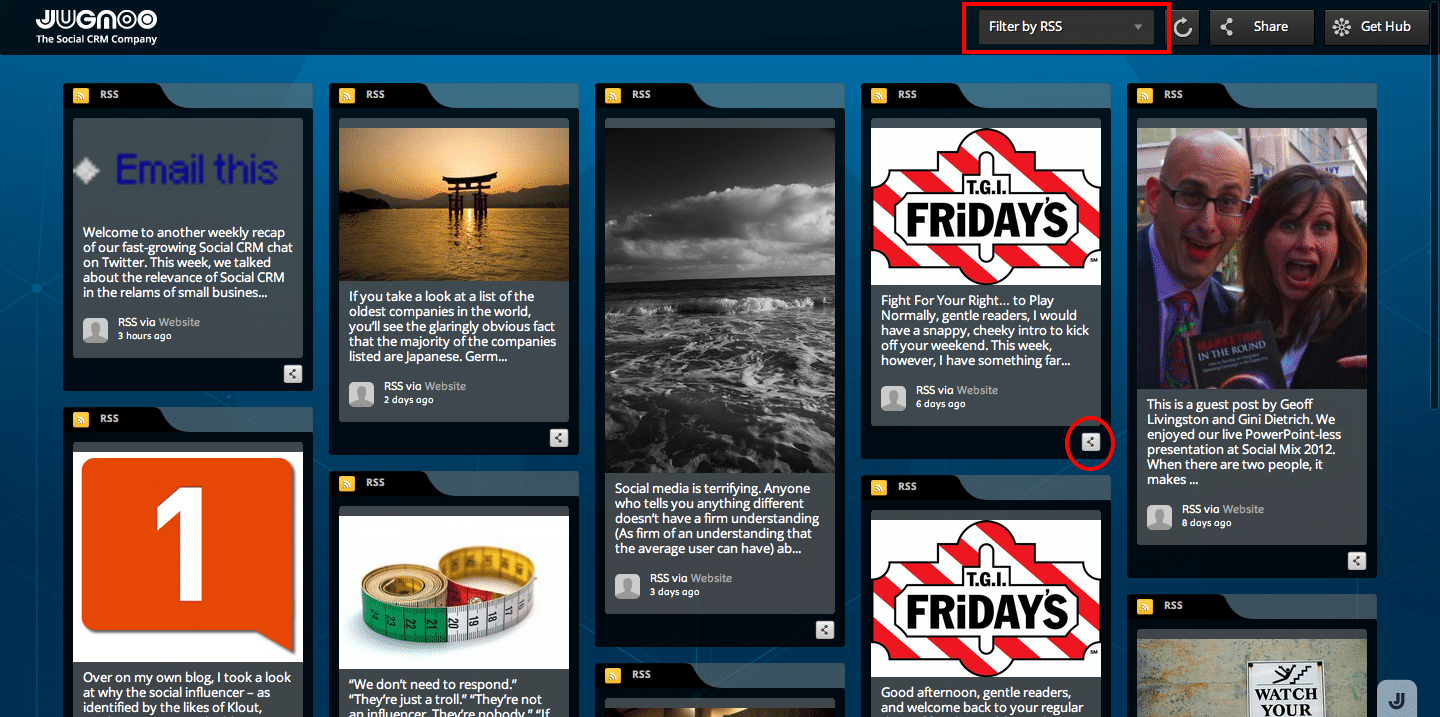
Kinda like a Pinterest board on steroids, our Social Hub? allows you to grab RSS feeds from various social networks and create a living, breathing hub where the most recent news around your choices can be displayed.

buzz RSS

Now, let’s say you want to connect more with the people talking about you from the Visualyzer results. You could set up a hub with feeds from their blogs, or Twitter account, or YouTube channel, etc, and use that to keep up-to-date with their latest updates or posts.

You can then reshare from the hub, send it as an email recommendation, tweet directly to the person, and more.

Let’s say @FeastInc, for example, tweeted that it was their pet’s birthday and you were a pet retailer. You could reply to them and wish them a Happy Pet Birthday, and then use the email function to send to your sales team and ask them to get in touch with @FeastInc to send them a goodie bag for their pet.

Or, you could see the URL for their most recent blog post, drop on over to leave a comment and mention the pet’s birthday in that comment too.

You’re building rapport; you’re showing you want to get to know them; and you’re rewarding for their support of you too.Who doesn’t like that?

These are just basic ideas using some cool tools that don’t even fall within the traditional social monitoring mix. When you partner them with the actual full social monitoring solution in the Jugnoo dashboard (released in the next 2-3 weeks) – well, the options become even more powerful.

And you still keep the fun factor of visuals, images and emotion, while making the connections that really count.

Works for me – you?

Ryan Moore ? My New Favourite Sportsman

You may or may not have heard of Ryan Moore. He’s a pro golfer who recently won his first tournament, the Wyndham Championship.

If you haven’t heard of him, you’re not alone – he’s still ranked 120th in the world and isn’t one of the first names you think of when you think “pro golfer”.

Yet despite his relative anonymity, Ryan Moore may just have made himself my new favourite sportsman. All because of $300,000.

Where Ryan differs from most other sportspeople, and certainly every other golfer it would seem, is that he refuses to be endorsed by any of the name brands that adorn other golfers. He buys his own clothes and golfing equipment, and often these are a mish-mash of some of the cheapest brands around.

It’s led to sports marketing companies questioning why Ryan is avoiding their pitches, when pro golfers have at least one brand sponsorship to their name. According to Ryan’s manager (who’s also his brother), it’s simple: “He doesn’t want to be a billboard.”

The $300,000 that I mentioned earlier? The projection of what Ryan could earn from sponsors – $200,000 a year for cap sponsorship, $20,000 for a chest logo, and $50,000 for a branded golf bag. And why is he my new favourite sportsman?

Simple. When mostly everyone around him is signing up for the big bucks, whether they like the brand or not, Ryan Moore is staying true to himself and showing that money isn’t always everything. His decision means that sports marketers may have to reconsider whether tapping up folks to be the face of a brand will continue the way it has or if it has to look at new ways to sell. And anything that helps move marketing and branding forward into new thinking can never be a bad thing.

Of course, this is the now. With Ryan winning his first tournament, his stock will go up and the offers will rise with it. Whether he’ll remain as loyal to non-branding when the million dollar endorsement offers start materializing is another thing. But for now… he’s definitely my new favourite sportsman.

How about you – is Ryan doing it right or will the marketing dollars win out?

photo credit: pga.com

© 2026 Danny Brown - Made with ♥ on Genesis