• Skip to primary navigation
  • Skip to main content
Danny Brown

Danny Brown

podcaster - author - creator

  • About
  • Podcasts
  • Journal

future of influence

Why the Klout Sale is Bad News for Social Scoring, But Great News for Influence Marketing

Klout - meh

In the last couple of days, it was announced that social customer experience company Lithium Technologies would be acquiring social scoring platform Klout for a figure reputed to be around $100 million.

If the deal goes through, it’ll be the close of a five year journey for Klout since its inception – a journey that saw it initially praised as a conduit to determine online influence, and then berated for various missteps that included profiling minors, privacy concerns, and questions around its algorithm and whether it measured influence or simply social signals.

On first look, $100 million looks a great number for Klout, and validation of seeing through the criticism that’s plagued the service, especially in the last 12 months or so.

However, far from being a success story, the sale of Klout highlights its failings, and in more areas than simply the evaluation.

$100 Million Ain’t a Whole Can of Beans

For any start-up looking to be acquired, $100 million probably looks an attractive figure on face value. However, given the financial history of Klout, it’s closer to a loss than a win.

Take a look at their investment history:

  • Initial seed funding in 2009;
  • $ 1.5 million Series A funding in April 2010;
  • $8.5 million Series B funding in January 2011;
  • $30 million Series C funding in January 2012.

Just by these “standard” investment rounds, Klout had received $40 million in funding by the start of 2012, which saw the company valued between $200 – $300 million just a couple of short years ago.

Add to that venture round funding in September 2012 by Microsoft (to utilize Klout’s services in their Bing search engine), along with further venture round funding by Draper Nexus Ventures in August 2013, and it’s safe to say that a large chunk of the $100 million price from Lithium will be eaten up by investors looking for return on their earlier capital.

When you take away the minimum numbers that need to go back to the investors, the number that’s left – $60 million – doesn’t add up to a success story for Klout.

On average, a company that’s received $40 million in funding is usually expected to be valued around the $400 – $500 million mark.

Look at Foursquare as an example – before their recent Series D investment round that brought in another $35 million, Foursquare had been valued at $600 million, with investment total of approximately $72 million.

Given that Klout’s investment of $40 million is just over half the Foursquare amount, it stands to reason you’d expect the overall valuation to stand at just over half of Foursquare’s $600 million – yet that isn’t the case, despite Klout claiming to have data on 500 million profiles, versus Foursquare’s 45 million users.

Yet it’s these physical numbers that highlight the low dollar numbers when it comes to Klout.

Physical Users Versus Fabricated Users

One of the biggest criticisms leveraged against Klout has been their method of forcing “users’ to opt-out of their service, versus opting in to be profiled. Klout’s method of operation was to create a profile of you on the Klout database, based on your public Twitter profile – but it didn’t matter whether you liked this or not, you had no choice in the matter.

When questioned on why they used opt-out versus opt-in, Klout’s response was their practice was no different from Google indexing websites via their platform. Except… people that wanted to be found on Google opted-in to be indexable. People that didn’t want to be found on Klout had to essentially log in to the Klout platform to delete a profile that had been created, that the person never wanted or agreed to in the first place.

While Klout would never admit to it, this opt-out practice was viewed by cynics as a way to buffer user numbers. It didn’t matter if people knew they had a Klout profile or not – all that mattered was Klout could sell their service to brands and advertisers as “500 million profiles”.

About Klout

Yet there’s a big difference between a profile and an active user. Whereas Foursquare’s 45 million users are active, and therefore valuable to marketers looking to understand shopping behaviours, etc, Klout’s profiles included bots, automated accounts, multiple accounts set up for news feeds only, etc.

You can have 500 million “users” to sell to a potential advertiser – but if only a limited percentage of these users are real people actively offering up useful data, then your service is immediately devalued.

A Lack of Future Strategy

Perhaps where Klout failed most, and in turn lost a lot of the previous evaluation of a few hundred million dollars, is failing to adapt their platform to not only the “influence” industry they in part created, but meeting user needs and reacting to an ever-changing, and more demanding, content-led space.

Klout’s raison d’etre has always been to determine how influential someone is online, and allocate them a score between 1 and 100 – the higher the score, the more influential the person. At least, in theory.

However, the problem with any generic scoring solution – no matter how technical you claim the algorithm to be – is that scores can be gamed, and they don’t reflect the bigger picture.

Even in the early days of Klout being seen as a darling of the nascent social influence space, its algorithms were pulled apart in spectacular fashion when Justin Bieber had a perfect score of 100, while President Obama – arguably the most powerful person in the world – had a score of 88, while the Dalai Lama scored at 90.

As a result of the criticism they received about this, Klout updated their algorithm to show more real-world influence as having a bigger impact. Yet they resolutely continued to use scoring as a measure of influence, despite the flaws that strategy continued to show and despite their peers moving away from the public scoring game.

This lack of innovation and fresh direction was highlighted even more when compared to products like Traackr, who came out with solutions like their Influencer Network Analysis.
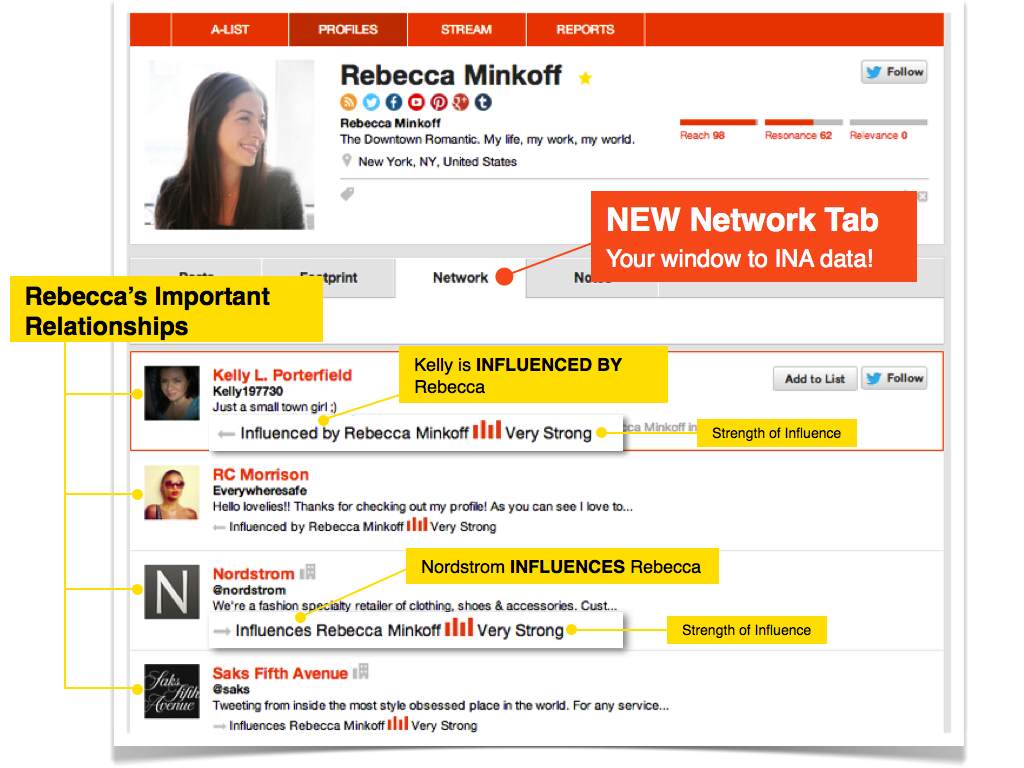
Traackr Influencer Network Analysis

This allowed users of Traackr to not only see who was influential based on real metrics like Relevance and Resonance, but also who essentially influenced the influencers – an added depth of identification that really laser-targeted the people you wanted to connect with.

Or consider Appinions, who measure offline influence as well as online influence, to offer a full spectrum of data and insights. This includes identifying the originating source of something that’s impacted discussion across the web, and how offline news stories and journalists drive online conversation and actions.

When comparing Klout’s social scoring algorithm as a measure of influence against real influence platforms that drive the insights needed for business goals, it was always going to be an uphill battle for Klout to be taken seriously as an influence marketing platform.

And then there were the Perks.

The ROI of Reach and Noise

Touted as a way to connect brands to the army of influencers in Klout’s database, Klout Perks were introduced in 2010 and were seen as one of Klout’s business models to monetize their platform.

Advertisers and brands would pay Klout a premium, which would differ based on the target audience and size of the promotion, and Klout would offer that brand’s product as a freebie to people who qualified based on their Klout score.

The problem was, there was no real relevance or context to the Perks. All that would happen is Klout would identify a bunch of people they perceived as influential in the brand partner’s niche, and – by giving them freebies like car test drives and airline trips – the Klout influencers would share their experiences and drive sales for the brand.

Klout Perks

Except that never really happened – or at least, not in the numbers that the brands probably expected, given the investments and amount of influencers promoting the brand’s goods.

The reason was simple – Klout didn’t dig deep enough into the audience of the influencer. They didn’t know if the followers of an influencer were in the market for the product being promoted; they didn’t know if they had brand loyalty elsewhere; and they didn’t know how contextual the influencer truly was in the area of the promotion.

This meant that, essentially, the Klout influencer was simply promoting without any knowledge of where their audience was in the purchase life cycle – a key factor in successful influence marketing campaigns (and something Sam Fiorella and I talk about extensively in our Influence Marketing book).

When you look at the public case studies Klout shares about their Perks, very few talk about tangible financial ROI. There are lots of examples of social shares, blog posts, etc., which is great for brand awareness. But for actual ROI and sales? Little evidence of success.

For brands that are spending upwards of $25,000 and more on Klout Perks, you want to see returns for your investment. The occasional example of ROI success after at least 400 campaigns and 1 million Perks being claimed is not a number designed to inspire confidence when it comes to breaking down your latest fiscal year’s marketing budget.

Klout’s Failure is Good News for REAL Influence

As I mentioned at the start of this post, $100 million isn’t chump change. However, given the financial history of Klout investment-wise, its business model of Perks, and its uncertainty as to what exactly it wanted to be (a recent pivot to a content curation platform seems too little, too late), you have to wonder what Lithium saw in the platform.

Perhaps it’s to identify influential customers (since Lithium serves the social customer industry), so that their issues can be resolved before they become an online crisis. However, that path could be fraught with negative feedback if customers feel they’re being ignored in lieu of “influencer customers”.

Perhaps it’s access to the data that Klout has. While there’s no question some of the data is for inactive accounts, there’s still a lot of information available for Lithium to integrate into its own solutions.

However, that’s for a future discussion once Lithium’s plans become clear. What’s clear right now is that Klout’s failure is a victory for real influence marketing technologies and strategies.

Social scoring was always a popularity game, with little relevance attached to actual influence – swaying a customer’s purchase decision at exactly the moment they make it – and more weight on social signals and amplification.

Now, with the flag-bearer of social scoring acquiescing to what almost looks like a desperation sale, the companies that are truly pushing the influence conversation forward can do what they do best, and meet the needs of brands and marketers that are looking for more than social shares when it comes to an influencer campaign.

Social scoring is dead – long live influence.

image: Jamie Koroluk

This article originally appeared on DannyBrown.me.

Does Influence Marketing Have a Future?

The business of influence

Last week, Forbes published an article entitled Who Are the Top 50 Social Media Power Influencers, 2013? by Haydn Shaughnessy. It followed similar posts by Shaughnessy on The Top 20 Women Social Media Influencers, also on Forbes, and a similar Top 50 list 12 months earlier.

The article soon came under fire from certain areas of the web, including Mark Schaefer’s Grow blog and Jure Klepic of the Huffington Post. Additionally, there were numerous conversations across Facebook on the Forbes article, with the majority of people discounting its validation.

So why did a publication like Forbes receive such criticism, and what does the discounting of influencer results like the one on Forbes mean for influence marketing in general?

Popularity is Not Influence

This is beginning to sound like a broken record, but popularity does not equal influence. While having 100,000 followers on Twitter might be a nice statement of your social proof (hint: it’s not really), does that make you influential (another hint: no)?

This is where the majority of the criticism of the Forbes article comes into play.

In his preamble to the list, Shaughnessy shares the “algorithm” behind identifying the influencers, and that he uses Twitter measurement platform Peek Analytics. That should raise the first red flag – Shaughnessy is only defining influence from a single platform.

However, it’s Peek Analytics’ own description that devalues Shaughnessy’s article even more. From the Peek Analytics website:

Social Pull is not a measure of a single individual?s ?influence;? rather, it is an audience-based metric that is a direct reflection of the quality and size of the Twitter audience that has been ?pulled? into following an account or mentioning a keyword @name, hashtag, or URL on Twitter.

So, Peek Analytics doesn’t measure influence; they measure data based on interactions. So why does Shaughnessy use a tracking platform that doesn’t measure influence to create an influencer list?

It’s this flawed approach that the majority of the criticism around the web has picked up on.

…this is a suspicious methodology to define social media influence, and that is about as charitable as I can be. – Mark Schaefer

With their tired standard of measuring Twitter followers, PeekAnalytics adds nothing to the conversation of influence measurement. Similar to every other list that has been made based solely on Twitter followers, there is no attention paid to the metrics of comments on their blogs, content quality and other social networks.?- Jure Klepic

…the thing that bothered me about the Forbes list is they clearly did it based on Twitter followers alone. There are two people on there I know, for a fact, they paid for their followers and don’t interact, engage, or build community. – Gini Dietrich

These criticisms, and others like them, clearly show that the social web has moved way beyond just numbers and a platform where spam bots are plentiful when it comes to defining influence in the truest sense.

Influence is Multi-Layered

The other core issue with the Forbes article is the very fact Shaughnessy limits measurement to a single platform. This is lazy analytics at best, allowing for flawed metrics to be used as a source of influence identification.

It’s also one of the reasons that a recent influence marketing survey of over 1,300 professionals highlighted the need for more accurate and informed data analysis, versus the approach currently taken by social scoring platforms.

Influence marketing survey key insights

For example, Klout’s algorithm only measures your public Twitter data – they need you to connect your other social accounts to offer any true accuracy. From a recent TechCrunch article:

Before we are able to incorporate any data into a person?s score, we need users to connect the network to Klout so we can begin to process the influence data.

So, much like Peek Analytics, they’re using a single platform to measure influence, as opposed to all the other social footprints you may have elsewhere. Klout competitor Kred is in the same boat:

To calculate your Kred, we analyze?billions of tweets?from the last 1,000 days.?We add your Facebook actions when you connect your account.

While there’s no doubt Twitter is an important part of the social media ecosystem, it’s just one piece in a very large puzzle. And it’s this reliance on Twitter data only that dilutes the effectiveness of social scoring when it comes to identifying true influence based on behavioural change, as opposed to reactions to a tweet.

Influence is much more than the sum of Twitter’s parts. If we, as marketers and brands, are looking to truly understand what drives actions in people – the definition of influencing someone – then we need to understand much more than a tweet or social network update.

  • Situational factors – what’s affecting someone’s decision-making at any given time?
  • Peer factors – who offers the most influence based on where you are in that decision-making process?
  • Financial – can you afford to buy, or are you more logical and prudent with your money?
  • Emotional – tied into the financial factor, does emotion for a product override common sense, logic and lack of funds?
  • Familial factors – who’s the decision-maker in the family and how does this impact a brand message being accepted?

These are just a few of the factors involved into identifying where influence may play a part, and who the influencer would be to instill the next part of the equation and, by association, action.

Is Influence Marketing Losing Its Clout?

So what does this mean for influence and influence marketing moving forward? Has the potential of influence already been nixed before it’s even had a chance to reach maturity?

After all, the criticism of a respected media publication like Forbes, as well as questions being raised on current social influence outreach and its effectiveness at ROI, would suggest influence is becoming a tainted topic.

And, to a degree, it is. Lack of results (shared or perceived) harm the medium, as brands (rightly so) look for return on their investments, beyond simple retweets and blog posts that add nothing to the bottom line.

However, as the results of the recent influence marketing survey we shared here show, it’s not influence itself that’s broken, but the definition of how we identify who influencers are today, and what they mean for a brand. Brands are still looking to use influence marketing as a key part of their tactics; but they do expect more.

The problem is we’re still placing “influencers” – whoever they may be – at the heart of the marketing circle, and not always defining what the context is when it comes to filtering them for a brand.

A simple example – Lifestyle Blogger A has a well-read blog, and primarily attracts an audience of women between the age of 25-44. So it makes sense that a brand whose demographics are made up of this audience should work with that blogger.

But the audience has a very different make-up. Blog Reader A is a single mom with two young kids under three; Blog Reader B is a married mom with one kid aged ten and one teenager; and Blog Reader C is a mom who has a child of college age, who’s no longer living at home.

All three of these reader segments fall within the broad category of “women between the age of 25-44” – but that’s where the similarities end.

Disruptive influence

Let’s say the brand sells toddler toys. Using a generic influence outreach campaign, the blogger might be successful at putting the brand in front of the Blog Reader A segment, but the message will be completely off-point for the other two, just-as-important segments.

This is the where the flaws of putting today’s definition of an influencer at the heart of the marketing circle appear; and why we need to move beyond this, and start putting the actual customer at the heart of the circle, and work back from there.

By taking this approach, we understand who the true influencers are – customers – and what they’re looking for, as well as who’s influencing their decisions at a specific point in time.

And if we can redefine influence to the people brands should really be taking notice of, and how to meet their needs and help with their decisions, we can reposition influence back to its true meaning and dispel its lack of effectiveness (perceived or real) currently “enjoyed” today.

In less than three weeks, that repositioning of influence will be ready to take the first steps…

Read Chapter 5 of Influence Marketing, “Situational Influence”, today – click here to download your free copy.

Influence Marketing: The Book

Danny Brown Sam Fiorella Influence MarketingIdentify and Manage the Influence Paths That Convert Brand Awareness to Customer Acquisition

Today, you face a brutally tough, maddeningly elusive new competitor: the ?wisdom of crowds.??Social media gives consumers 24?7 access to the attitudes and recommendations of their most?engaged peers.

These?are the views that shape buying decisions.

These?are the views you must?shape and use.

Influence Marketing?won?t just help you identify and enlist key influencers: it will?help you manage the influence paths that lead consumers to buy.

By sharing empirical evidence?of hard-won lessons from pioneering influence marketers, Danny Brown and Sam Fiorella provide?a blueprint that moves influence marketing beyond simple brand awareness and into sales?acquisition and customer life time value measurement. They integrate new tools and techniques?into a complete methodology for generating more and better leads?and converting them faster,?at higher margins.

  • Put the?customer?not the influencer?at the center, and plan influence marketing accordingly
  • Recognize where each prospect stands in the purchase life cycle right now
  • Clarify how your consumers move from brand preference to purchase
  • Identify key micro-influencers who impact decisions at every stage
  • Gain indispensable insights into the?context?of online relationships
  • Recognize situational factors that derail social media brand recommendations
  • Understand social influence scoring models and overcome their limitations
  • Re-engineer and predict influence paths to generate measurable action
  • Master the ?4 Ms? of influence marketing: make, manage, monitor, measure
  • Transform influence marketing from a ?nice-to-have? exercise into a powerful strategy

Available May 13, 2013,?Influence Marketing?provides a blueprint for predicting and managing influence paths that generate measurable action and impact on the business? bottom line for both B2B and B2C organizations.

This book heralds in the next phase of this evolving industry and provides actionable strategies that will define how influence marketing is executed for the next 10 years.

Buy from these bookstores below:

Influence Marketing book Influence Marketing book Influence Marketing book Influence Marketing book

The Grading of the Social Web and Its Impact on Influence

Robots replacing humans

Where now for influence marketing

Last month, Twitter published an article on their developer blog, about new metadata being added to the Twitter API. There were two additions ? one to help identify the language of a tweet, while the other was the ability to allow developers to ?rank? tweets.

This second addition is of particular interest when it comes to influence marketing, and how we identify influencers, since it offers the potential to further dilute the ability to truly connect relevant influencers and advocates to the brands that are looking to work with them.

Now, in fairness, Twitter hasn?t divulged exactly how the ranking ability may work, apart from the option to possibly gauge tweets by a ?none?, ?low?, ?medium? and ?high? rank. It may be there?s a lot more context to the way the API will identify these tweets.

However, in the meantime, the worry is that true influence, yet again, is being demoted to nothing more than an algorithmic rank with no real context behind it. When this happens, it takes us back to the ?influencer elite??I?ve talked about previously on the Influence Marketing blog.

Which begs the question, can the everyday influencer still exist?

The Grading of the Social Web

It?s not just Twitter that?s taking this approach. Take a look at Google and the importance they?re placing on their Authorship Markup algorithm. Or Facebook with its ever-changing algorithm that places more emphasis on paying for a Sponsored Story to have your content seen versus organic appearance in a feed.

There?s no doubt that the social web is becoming an arena of rank and perceived import ? yet questions remain as to the validity of the import when it?s based on how well you play with a platform?s rules.

For example, let?s say you don?t have Google Authorship enabled on your blog or website, yet you write a fantastic white paper on the origins of mankind that challenges everything we?ve believed until now.

When someone searches for ?the origins of mankind? on Google, your expertise would (should) probably be the one that people should read. Yet because?someone with less expertise utilizes the Authorship Markup script, they actually appear more reverential than you?for that particular search.

The same goes with Twitter?s new API. Let?s say they base their authority score on the amount of retweets and engagement a tweet receives. While this is a good starting point, it lacks the more important aspects of context, perception and situation at the time.

This is particularly true when large events are happening.

Let?s say someone uses the hashtag for the Oscars to post an asinine comment about the price of popcorn at their local 7-Eleven. It gets 1,000 reweets and 500 favourites. That may appear as a high scoring tweet based on the new API.

But does it have the context of an Empire Magazine journalist in the UK only getting 20-30 retweets as he/she live-tweets about the event from the UK? Doesn?t their expertise in the movie arena make them more authority-driven?

This is the problem with grading importance based on reactions versus instilling a true action ? the sign of an influential impact. It also changes the very fabric of influence ? no bad thing on its own, but when it comes to trying to clear the muddied waters of the last few years, it can add to the confusion.

Which brings us back to the topic of this post.

The Everyday Influencer and Where They Fit Today

One of the criticisms levied at influence marketing today is the lack of results for brands using the medium. And that?s a fair criticism.

This can be attributed to several things ? generic social scores with no real relevance to the brand in question; lack of understanding and education on the brand?s behalf; and the gamification of social media channels to be seen as someone of influence.

Whatever the reason, influence has undergone some drastic changes in the last few years when compared to Carnegie?s principle, and not always for the better. The biggest impact this has had is in nullifying true individual influence, the kind that brands really want ? and need ? to connect with.

Activity and popularity online has led to people being seen as influencers, while the true influencers ? the ones not worried about social scoring and perceived ranking ? are the ones that should be identified.

These ?everyday influencers? are finding themselves marginalized because they?re not playing to a computational score; nor are their hands being tied by a search engine?s goal of making you use all their products to be seen as relevant.

The problem is, these are exactly the people brands should be connecting with. They?re the advocates; the consumer marketers; the people who truly have the ear of those that make a difference when it comes to the purchase cycle of their friends, colleagues and peers.

As public scoring and authority plays continue to evolve and find bigger footholds across the web, the question becomes:

Can the everyday influencer still exist, when the games being played to ?be? one nullify results based on much deeper questions?

My co-author on Influence Marketing Sam Fiorella and I believe so. In the next few weeks, we?ll show you why and, more importantly, how.

A version of this post originally appeared on the official Influence Marketing blog. Subscribe today and stay up-to-date with the latest innovations and future trends in influence marketing.

© 2026 Danny Brown - Made with ♥ on Genesis