• Skip to primary navigation
  • Skip to main content
Danny Brown

Danny Brown

podcaster - author - creator

  • About
  • Podcasts
  • Journal

google plus

Is This Google’s First Steps in Full Product Integration with Google+ and Core Products?

So today I opened the Google home page to check my Gmail account, and I was greeted with this funky image:
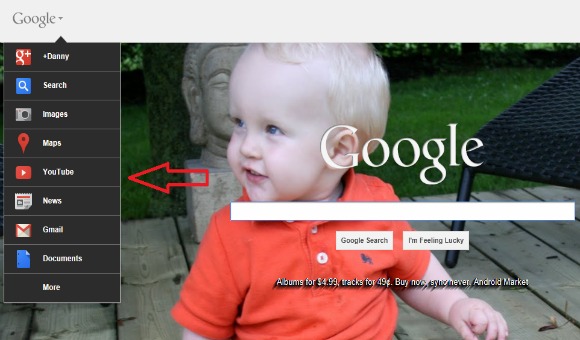
Google sidebar

As you can see from the left-hand sidebar, the core products from Google are there for you to access immediately, as opposed to links within your account.

Which makes me wonder – could this be? the first steps in Google bringing all their solutions under one integrated offering? If so, it’d really push Google+ into the mainstream and grab those Gmail users (and web users) that currently have no inclination to try the service.

Google’s already made bold statements about their plans for Google+. If this sidebar is the start of that – particularly the simplicity of the approach – 2012 could be an interesting time for the platform.

Especially if you think of some of the possibilities, if Google were to integrate a drag-and-drop feature:

  • You click YouTube to edit an uploaded promotional video.
  • You add product?images from your Picassa account.
  • You tag Google Maps to show which stores are?running your promo.
  • You share across YouTube, Google+ and other social accounts – all from one sidebar.

From feedback over on Facebook and G+, it seems this might be a North America-led roll-out to start with – global in the New Year?

Your move, Facebook.
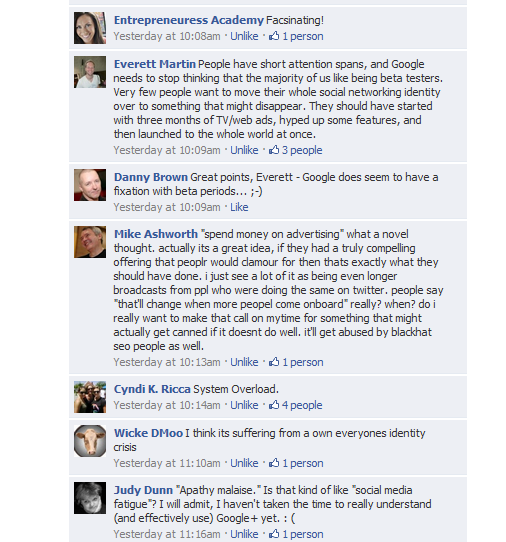
The Google Plus Apathy Malaise

Danny Brown Google Plus FB Question

Yes, Google+ is just two months old, and yes, they’ve had a great uptake in numbers using the service (currently 25 million and counting). But there’s a growing amount of talk about how it’s not majorly different from what’s currently out there.

Danny Brown Google Plus FB Question

Additionally, the majority of users fall within limited categories – early adopters, tech geeks, social media “power users” and marketers/agencies trying to decide on its potential business value.

For Joe Public, though, Google+ remains an anomaly, and one that has a big question to answer – mainly, “Why should I leave Facebook when everyone I know is on there?”.

Personally, I’m enjoying Google+, but I’ll admit the early novelty has worn off and I use it less than Facebook. I’m hoping that the various tools and apps Google has at its disposal will make an appearance soon and integrate smoothly, as I feel that could be where the real Wow factor comes into play.

We’ll see. For now, from a lot of the people I’m connected with, it’s okay but could be better.

How about you?

Google+ Is the Social Network That?s All About Search

Google Plus

Google Plus

This is a guest post by Sean McGinnis.

Did you hear that Google launched a social network called Google+? Of course you did!

In the past, Google took a stab at social by purchasing Orkut. Later, they launched both Google Buzz and Google Wave with little success. Now comes Google+.

Kinda seems like Google is the Elizabeth Taylor of the social world, doesn?t it? They?re going to keep trying until they get it right. Given those four trips down the social aisle, and the fact that employee bonuses are tied to getting social right this year, it?s pretty clear Google is borderline obsessed about social.

I wonder why that is?

So have a lot of other people.

In fact, there?s been a lot of handwringing and hypothesizing about why Google launched Google+. Some believe it is designed to kill Facebook; others that it will kill Twitter; still others view it as a play to move everything into the cloud and take on Microsoft and Apple.

I?m not convinced.

I think Google+ is a forward thinking play to keep search market share. Coincidentally, it also opens up billions and billions of new real estate to sell Google ads against, but that?s secondary (believe it or not).

Google Makes Money By Selling Ads

You see, Google has one objective; to sell advertising. Google brought in over 28 billion dollars in ad revenue in 2010 ? 96% of total revenue for the year; and that number is already growing roughly 30% this year.

One of the things we all know is that you make more money when more people see your ads, whether that?s a TV show or a Google paid click within a search result.

Google AdWords

Google?s goal of selling ads is directly served by making services that are as valuable as possible. But, what?s valuable in the context of search?

Think about search for a minute. You ask a question?you expect an answer; a correct answer. That is why you go to a search engine, isn?t it? I know that?s why I go to a search engine. I?m looking for something and I need to find it. So, the more accurate the search results, the more people will want to use a given search engine.

The question is how does one go about creating a better search engine?

One Question. One Answer.

Think about it for a minute. If Google were God (not to stretch credulity too far or anything), you?d ask one question and get one perfect answer. They wouldn?t need to serve you 10 or more possible answers to your question. They would know exactly what you were looking for, even if you were unclear in how you presented your question.

I mean, God would know your intent, right? God would know exactly what you were looking for. I?m really not trying to compare Google to the Omnipotent One, but I am suggesting that in a perfect world they (along with every other search engine) would like to be able to divine what you were looking for and present it to you as fast as possible, maybe even before you asked for it.

(But maybe make you click through an ad in order to get the answer).?

Even more importantly, they would know that what I was looking for may not be what you were looking for.

Enter Personalized Search

The quest for search perfection began long ago. Google made great strides in this direction by including the concept of authority into their algorithm. By indexing the link structure of the web and calculating the value of the structure, Google (unlike many other early search engines) was able to eliminate a lot of spam from their search results.

But it wasn?t enough.

Website owners became wise to the value of links to influence search results and backroom deals, link purchases and other unsavory activities began unduly influencing search results. So, in 2005, Google released a feature called Personalized Search.

Personalized Search

It was a new and shiny object at the time. It represents (to me) the first push down the slide we are accelerating down today. Google started to present back to you (provided you were signed into your Google account when you ran a search) results that were marginally different from other users. They started to personalize those result to you.

Think about that for a minute. What better way to ensure a search engine could answer your question?

In 2009 Google extended Personalized Search to all users, whether logged into their Google account or not.

Over the past 6 years personalized search has improved some of the search experience, but only on the margins. There?s a number of reasons why Google and Bing chose to move slowly in the area of personalization, but that?s fodder for a different post.

A New Dawn for Personalized Search

Here?s the thing about personalized search. The more Google knows about all of us, the more they know about our like, dislikes, profession, connections, friends, enemies, content types, areas of influence, etc? the more they can customize the search experience.

In addition to Google+ giving all that information and more to Google, the introduction and proliferation of the +1 button allows Google to gather signals across the web of what you like and don?t like.

When we use Google+, we are creating data, all of which is within the Google network. No longer is Google relying on facebook or twitter data to learn more about you. That?s why it is so critical that Google get social right. Because social is where the data action is. It?s where we freely give up information about ourselves; where we create the connection nodes that Google can learn from and serve up a better search experience.

So while Google+ may represent a number of things tactically, the business strategy behind it is, in my view, directly correlated to their core business ? search.

More eyeballs means more ad revenue, and the best way to secure eyeballs is to have a near flawless search experience; intuitive, fast and predictive. The only way that happens is when a search engine LEARNS your tendencies ? and social is the best way to glean those tendencies.

That and it creates a few billion extra pages to sell ads against.

What do you think?

Sean McGinnisAbout the Author:?Sean McGinnis consults with businesses on digital customer acquisition and loyalty programs at?312 Digital.?Sean spent much of the last decade leveraging his law degree and 12 years of digital marketing experience by assisting law firms across the country create compelling online marketing programs. He is also co-founder of the group blog?12 Most. Sean currently serves as Managing Director and CMO?of?Multistate Edge, an online bar exam preparation company. You can find Sean on Twitter at @SeanMcGinnis.

© 2026 Danny Brown - Made with ♥ on Genesis