• Skip to primary navigation
  • Skip to main content
Danny Brown

Danny Brown

podcaster - author - creator

  • About
  • Podcasts
  • Journal

influence

It’s Time to Push Back on the Growing Fluff of Influencer Metrics

Influence marketing metrics

The end-result of any good marketing effort is to identify, engage and nurture the most qualified prospects, ensuring the leads generated drive the highest customer acquisition rate; or at least it should be.

There?s been a backlash towards the marketing industry, marketing professionals and even some marketing software platforms because of what many see as their inability to measure the direct result of their efforts vis-?-vis the business? bottom line.

Marketing ? and social media in particular ? is often criticized for being a soft-science.

Critics point to exercises such as branding, community building and social engagement as examples of efforts that may raise awareness of the brand name but are rarely able to link directly to the specific sales or profits generated by those activities.

The need to measure the return on investment (ROI) of social media activities ? and by extension marketing ? has become a rallying cry of business executives and pundits alike.

Others claim that many modern social engagement programs are ineffectual due to their focus on short-term strategies instead of long-term value.

Influence, or Influential Fluff?

Here critics point to the trend in acquisition of simple measures of success such as followers, ?Likes? and shares, or even the use of social influence scoring platforms to identify brand advocates.

These short-cuts fall far short in identifying real influence, and instead drive poor and inaccurate results because they avoid the real work required to drive long-term business value and bottom-line results.

Criticisms aside, the practice of influence marketing must be re-strategized if it?s going to become an effective marketing tactic for businesses and gain the favour of executives that control marketing budgets.

The advent and use of social influence platforms where scores are the key metrics is not influence marketing. These platforms are a good exercise in product and brand amplification – but?true influence marketing is about measurable customer acquisition and lead conversion.

The practice of influence marketing needs to return to driving measurable sales instead of broad brand awareness. Our book, and this blog, will help your business drive that goal.

Stay tuned – it’s about to get interesting again.

The Fallacy of the Democratization of Social Influence

Influence and the social web

Influence and the social web

When we currently think of influence, we probably think of social scoring platforms like Klout, Kred and PeerIndex. These are the early adopters to the social influence space and, as such, have built an impressive level of awareness around their platforms and definition of influence.

Proponents of social scoring have praised Klout, as the most popular platform, for democratizing influence – allowing anyone to be an influencer regardless of audience size, social standing and location.

While it’s true that social scoring can start the process of finding influencers, it’s not quite as clear cut when it comes to being democratic around influence itself.

Social Scoring Silos the Elite

The problem with any scoring system is that it only rewards those with a high number. Want to buy a car? Tough luck if your FICO score is under a certain amount.

The same goes for social scoring in the influence space. Want to have a new Cadillac to test drive for a weekend? You better have a score over X amount. Free flight or upgrade to first class hotel accommodation? Make sure your score is high enough.

This engenders an “us against them” mentality.

Jane Average may be a better person to drive conversation and foot traffic to a car dealership because she’s a gearhead yet Joe Average, who has no intent to buy that car brand but has a higher Klout score because he’s more active online, is the one that gets the car keys.

This elite rewards system now causes another problem – it begins to affect the natural tone of online conversations, as those below the fold realize they can change their language online and be identified as an industry influencer because they’re speaking about a certain brand more.

As the online language changes, the algorithms are rendered ineffective because now everyone truly is an influencer – and yet, they’re clearly not.

The True Definition of Influence

Which brings us to the real crux about influence – who truly impacts how a decision is made and at what point in the purchase cycle of a customer does this decision get made?

  • Is it as a result of a socially active broadcaster, or someone else completely?
  • And, if it’s someone else, do social scoring platforms have the ability to identify that person?

My belief is that social scoring is not true influence, and that’s why the democratization of influence through social scoring is a flawed, if worthy, ideal.

It’s one of the reasons that an early mover like Kred is moving away from scoring as a defining metric. There are bigger pictures and scenarios at play at every single touchpoint of a customer’s journey through an influence-led path, and the results of who actually influences their decision may surprise you.

Influence decision process Yet it’s these decisions that truly matter to a brand when it comes to influence marketing – because scores and amplification will only get you so far. No company can remain in business on the amount of retweets and Facebook Likes they received alone.

The conversation around the future of influence is just getting started – and it’s not about an elite partygoer trading on online noise and a grade…

[vimeo]https://vimeo.com/65202873[/vimeo]

A version of this post first appeared on the Influence Marketing book blog.

State of Play for Influence Marketing in 2013 – Infographic

Crossroads of influence marketing

Businesses are now competing with ? and often losing to ? ?the wisdom of crowds? in the branding battle. Identifying individuals who sway online consumer opinion on specific topics and within specific communities has become critically important to marketers and public relations professionals.

A slew of social scoring platforms have emerged with claims that they can identify who influences who online while providing various tools and scoring systems to rank those who are influential and those who are not on a variety of topics.

However, as with most early adopters, their efforts have been widely criticized. Some say they?re just misunderstood and that the technology is just too new.

Either way, there?s one certainty: Marketers and public relations professionals are taking notice.

Earlier this year, ArCompany and Sensei Marketing surveyed marketing professionals around the world in the ongoing effort to better understand this growing industry and where businesses stand on the issue.

  • Can social influence truly be measured?
  • Is anyone using them?
  • What?s the future of influence marketing?

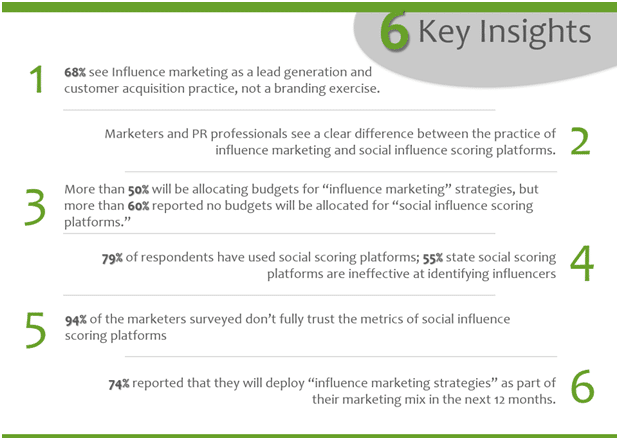
Influence marketing survey key insights

We’ve created the following infographic to highlight some of the key findings:

  • How marketers define Influence Marketing
  • What budgets they?re allocating to Influence Marketing in the next 12 months
  • How do marketers rate various social influence scoring platforms
  • What successes they have had with social influence scoring platforms and if they plan on using them in the future
  • The demographics of audience surveyed

What’s clear is social scoring, while recognized, is being questioned more, with businesses demanding better return for their investment. The technologies that can provide this will be the ones leading the charge in this Third Wave of Influence Marketing.

How about you – how does this data reflect your own personal experiences with influence marketing? I’d love to hear your thoughts in the comments.

Publish the infographic on your site – use the Embed code at the bottom of this page:

IM infographic

Influence Marketing bookBuy the book that offers the methodologies that answer the needs raised in this report: Influence Marketing: How to Create, Manage, and Measure Brand Influencers in Social Media Marketing

Book Authors: Danny Brown & Sam Fiorella
Copyright: ? 2013 by Que Publishing
ISBN-13: 978-0-7897-5104-1
ISBN-10: 0-7897-5104-6

?Survey Sponsored by:

arc-logo
sensei-logo

Why The Conversation Prism Misses the Boat on Influence

Conversation Prism

Conversation Prism

Recently, Altimeter analyst Brian Solis released the fourth iteration of the Conversation Prism, a visual representation of where the social web stands today.

As part of this update the prism included influence, in a nod to how key this area of social media has become for today’s businesses, in both goals and tactics. Unfortunately, like many other examples, the influence part of the prism misses an opportunity to move beyond the obvious and really discuss where influence is going.

By primarily highlighting social scoring platforms like Klout and Kred, the prism talks less about influence and more about amplification, popularity and ego-centric versus customer-centric platforms (thanks for that last phrase, Chris Heuer!).

For me, this misses the much bigger influence picture, so I reached out to Brian on the original LinkedIn post, and discussed the inclusion of scoring and the exclusion of better solutions.

On Moving the Influence Conversation Forward (Or Not)

DB:?What stands out is the Influence line. Same old platforms, either based around scores or single networks. Where’s the innovation? Where are the new leaders that are really pushing the influence discussion forward? Companies like Traackr, Appinions, InNetwork Inc., Tellagence, Measurely, etc? With their exclusion and your focus on the technologies that are questionable when it comes to measuring influence, it dilutes this data and leaves it looking a bit outdated even as it’s just published.

BS:?Those companies are indeed leaders in the field. In fact, I’ve written about Digital Influence going back to the late 90s. However, their place is not on this version of the prism as the majority of them are services rather than networks. So, it’s more focused and therefore allows it to be iterative in a systematic fashion.

DB: Klout isn’t a network. Kred isn’t a network. PeerIndex isn’t a network. There is no networking to be had on these sites. Indeed, PeerIndex’s own chief data scientist sees them as the type of company that provides data and consultancy services to their clients. Even taking that aside, though, these companies aren’t really measuring influence – they need you to add your other networks for them to successfully “measure” you.

By that definition, they’re saying you’re only influential based on your public Twitter presence (since that’s all they effectively measure without your strict permissions and connecting of other accounts). It’s why their inclusion on a line of “influence” is skewing the data and reducing any validation of the prism itself.

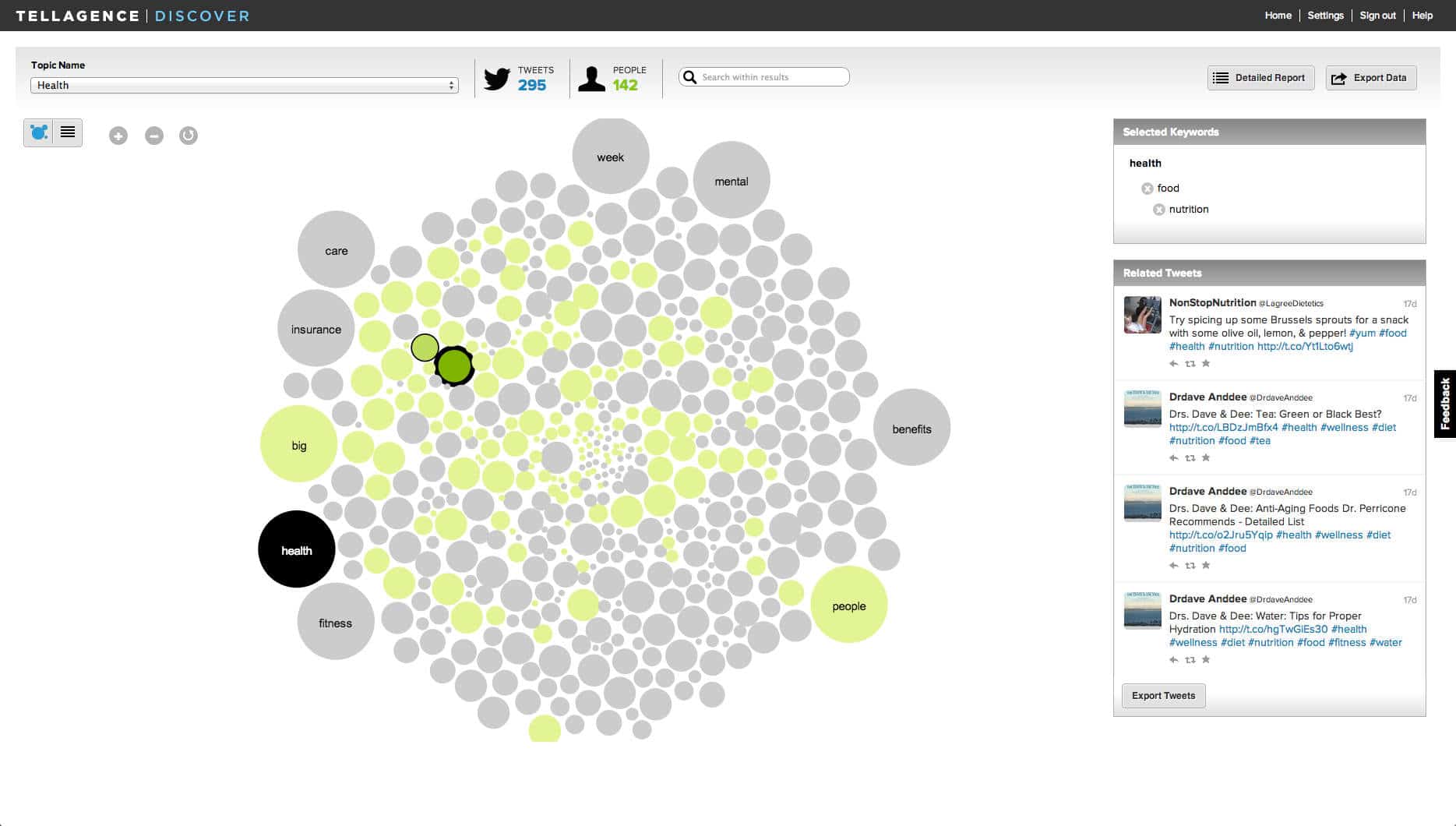
If you want to highlight true influence, look at how Tellagence tracks the ebbs and flows of influential communities and how that changes; or Traackr’s INA solution of who influences the influencers; or Appinions and their use of offline data and reactions to flesh out online influence; or Measurely and their parent company, Lymbix, and how they can successfully identify the emotion an update or content instills in you, making it easier to identify what type of media, content, etc., to use when looking to attract that audience. *That’s* influence – scoring isn’t.

Tellagence Discover Visualization

BS: I tend to disagree…they are networks. And, if you read my report, you will see how I trash the “idea” of scores. Might help to read first. Saves time when you see we are in agreement.

DB: I read that report when it came out, and questioned it at time of publication. It proposes that scoring platforms track more than they do; they don’t. The majority of information they use is from the Twitter firehose, regardless of what they would have you believe (why do you think Kred is so worried about the legal case with Twitter?).

But you have to be consistent as well; in one breath, you say they’re influence platforms (your prism) and then in the other you say they don’t measure influence, but the potential (something we do agree on, though probably not to the same level). And I stand by the definition they are not networks – unless you call a +K a true interaction along the lines of a Twitter interaction or a G+ conversation. They are data repositories – nothing more, nothing less.

BS:?No…no the report doesn’t draw that conclusion at all…in fact, it’s quite the opposite. And in terms of consistency…I’ve 10 years of research, development and experimentation in digital influence. My published work speaks for itself. In regards to an infographic that has “influence” as a category and not as a validation of the social networks that purport influence as a standard, that’s between you and those developers…

I merely created a sliver because the traction of some of those networks has the notable attention and budget of some of the biggest brands in the world. The center of the graphic is there for a reason. So, you can either try to pick a debate that at its root is out of context or you can focus your time on teaching other people about the merits of the services that help brands do a better job i.e. Traackr, eCairn, and the like.

And don’t forget, I co-founded and sold Buzzgain, which was an early player in this arena. If you step back from a ping pong game in the comments, you’ll probably find that I support your message and mission.

At this point I decided to not reengage as the conversation seemed to turn from a discussion about influence into a promo for accomplishments over questions about the inclusion of certain platforms when others would appear more suited to be there.

However, there were some valid points made, and some less valid ones, that deserve addressing, so let’s dig in some more here.

The Idea of Influence Platforms as Networks

Solis’s main reasoning for the inclusion of Klout, Kred, etc., versus more relevant platforms when it comes to actual influence, is that the former are networks while the latter are more service-led.

Yet within these platforms, there is absolutely zero networking opportunities or functions by today’s definition of a social network (unless the awarding of Kred or Klout points via a simple button click is classed as networking). Additionally, if they are networks, then shouldn’t they have been placed in the Network area of the prism?

However, moving beyond that simple overview, even the platforms included see themselves as services. Kred’s business model is to provide the data they gather to their clients, and act as a consultancy on how best to use them.

Kred for Brands

The closest influence platforms – public scoring or otherwise – come to “networking” is within the InNetwork model, where brands and influencers can connect directly within the portal and agree on project deliverables, compensation, etc. Even that, though, is limited to two parties, which makes it a more gated community/network versus a truly public one.

The Potential for Influence versus Actual Influence

In the report that Solis refers to, he speaks of social scoring platforms offering the “potential for influence” and this is where we definitely agree.

During research for our book, Sam Fiorella interviewed PeerIndex founder Azeem Azhar, who shared this interesting and definitive statement on where social scoring stands in the influence sphere:

There’s no real way for companies today, at a large scale, to identify who are the nodes that are more likely to spread messages around given categories. If you’re looking for the 7 people most important to me right now, PeerIndex isn’t for you. If you’re looking for the top 70,000, look to us. That’s where PeerIndex is and where we’re going.

There are two key parts to Azhar’s quote: influence can’t be built at generic scale, which is what scoring platforms profess to offer, and real influence comes from much smaller communities and interaction.

It’s why the platforms I suggested should be in the influence sector of the prism make much more sense than the current scoring-led inclusions – they’re measuring real influence and what that means for a business, versus those that may or may not be influential and lack relevance because of that.

The Social Bubble Needs Popping

I’ll freely admit I’m more than a bit biased when it comes to discussing influence and where it stands today, as far as the social web is concerned.

For the last three to four years, I’ve been a vocal critic of the data and identification methods that scoring platforms use when it comes to determining influence. They’re built for generic metrics, that agencies and brands can use to start the real legwork.

Indeed, in a recent survey of more than 1,300 marketers, brands and agencies commissioned by ArCompany and Sensei Marketing, 94% said “they didn’t fully trust the metrics provide by scoring platforms”, with 55% stating that “scoring platforms were ineffective at identifying influencers.”

influence marketing survey

These are the very companies, brands and professionals that the Conversation Prism is geared towards, and highlights why the continued inclusion of scoring platforms is in danger of diluting the authority of the prism itself.

If we’re to truly move beyond the social media bubble that seems to regurgitate the same names and platforms year in, year out, we need to offer real answers and solutions versus those that have bigger awareness but less relevance.

Once we do that, everyone benefits, because only the best and most relevant information is being offered. And isn’t that where we all aim to be anyway?

image: ConversationPrism.com

You can download the full Conversation Prism here.

InNetwork, the Drive for Authentic Influence and What It Means for Brands

InNetwork influence roster

InNetwork influence roster

In the book Influence Marketing, we dedicate a chapter to some of the platforms we felt were leading the way in the next wave of influence marketing.

These platforms include Traackr, Tellagence and others, for the way they’re moving beyond generic influence and actually delivering business intelligence and results.

Of course, the limitations of a book, as well as how fast this space moves, meant as soon as we’d finished, new platforms came into play that impressed just as much.

One such platform is InNetwork, from Nova Scotia, Canada.

Quality Assurance and Influence

The beauty of the platforms that are moving the influence conversation forward is that they all have something different to offer, and can either complement each other or be used because of these differences for specific campaign needs.

  • Traackr, for instance, has their new INA solution, which allows you to see who influences the influencers (a key factor for success in the methodology we present in the book);
  • Appinions takes into account offline data, which counters the “you’re only influential if you’re online” approach that the likes of Klout take;
  • Tellagence tracks the ebb and flow of influence across communities, and helps identifies the next layer or generation of influencers.

For InNetwork, their differentiating factor is the authority stance they take when identifying influencers.

InNetwork initial influence

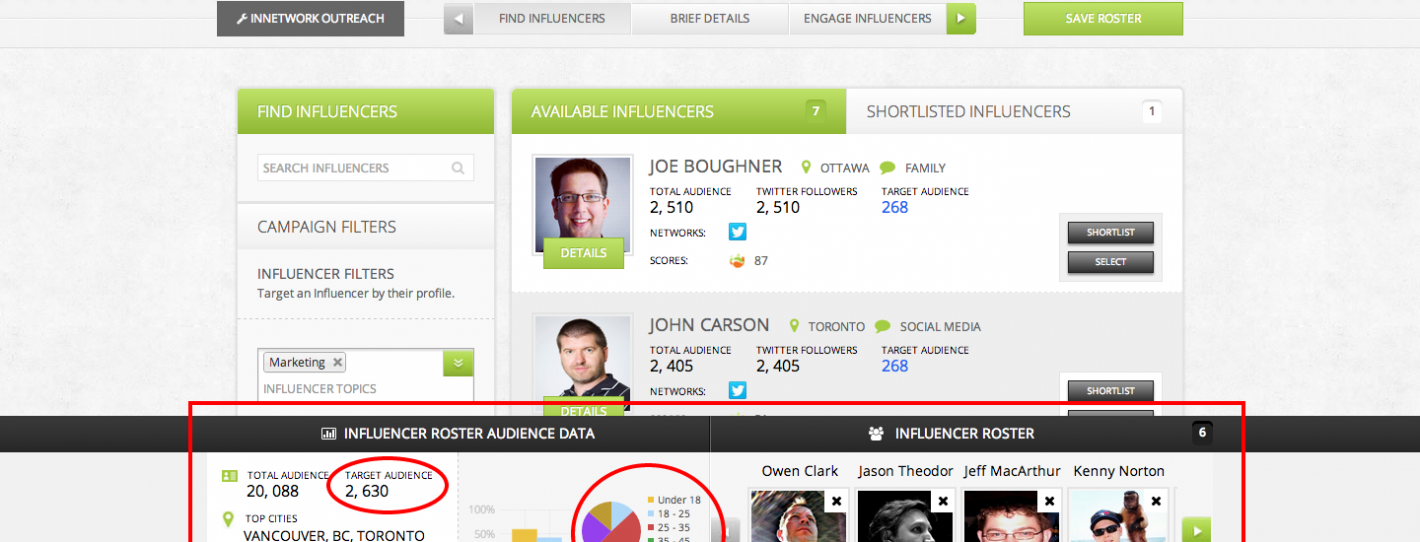
When you use InNetwork as a marketer and you set up your first campaign, you enter the keywords around the industry you’re in, and the target audience for that industry. That starts to populate InNetwork’s influence roster, as highlighted in the image above.

There are two types of influencers on InNetwork – registered and searched. The registered ones are those that have connected their data to the InNetwork database, and these are highlighted by blue stars.

The searched ones are those that haven’t registered with InNetwork, but have dropped into your search based on keywords used.

This is where the first part of the InNetwork Authority metrics comes into play.

When an influencer registers, they are manually curated by the quality control team at InNetwork, who verify authority on a topic, that they aren’t a bot or fake account, that the numbers add up, and that the influencer actually knows what they’re talking about. Only then do they gain access to the system.

This offers an immediate benefit for brands used to using social scoring platforms for “influencer outreach” campaigns. No more generic, no more false expertise – instead, real influencers with real audiences.

But the authority doesn’t stop there.

The True Audience of Influence

Once you start to use the various filters while setting up your campaign, the audience number of the influencer changes.

While someone may have a collected “follower” number of 10,000 across Twitter, Facebook, blogs, etc, not all 10,000 are going to be interested in the same thing.

For instance, a marketing blogger’s audience may be made up of small business owners, Fortune 50 executives, non-profit volunteers, etc. They need different information for different strategies.

Likewise, a lifestyle blogger may have married moms with teens, single moms with a toddler, retired moms, etc. Again, they’re going to need different messages targeted to their different buying needs.

As you add extra keywords and demographics into the InNetwork algorithm, it starts to show you what the true audience size for these filters looks like, as shown in the image below.

InNetwork true audience size

Now, instead of a non-targeted couple of thousand followers, you have access to a very targeted couple of hundred, that are in your target audience demographic and trust the advice of that particular influencer on that topic.

It immediately ramps up the success potential versus throwing a generic message at 5,000 audience members and seeing what sticks.

The more filters you add, the more targeted results you get, until you have a roster of influencers with a warm and engaged audience that’s right for your brand and the message/product/service you’re trying to promote.

The One to One Relationship Factor

Now that you have your chosen influencers, InNetwork adds the final piece of the authority puzzle.

Brand managers, or whoever’s responsible for the relationship with the identified influencers, now have access to a Brief and Statement of Work area, as well as a private messaging function directly with the influencer, as shown in the two images below.

InNetwork 5 brief

InNetwork engage influencers

Here, the brand can connect with the influencer directly, and propose their project as well as their requirements, goals, expectations, compensation and more.

In return, the influencer can negotiate that statement of work, to ensure that the message that’s shared with their audience is right for them; doesn’t impact the trust of the influencer; and offers a fair reward for the work that’s being done.

With both sides working together like this, it ensures the brand’s message is going to the right audience, and that the brand is allowing the influencer to share the message in a way that’s relevant to their community.

It’s one of the core reasons any campaign succeeds and, more importantly, moves beyond a short-term campaign and into a longer term loyalty and advocacy relationship.

Once the campaign finishes, the influencer can be “ranked” for relevance of message, results, goals met, and general working relationship. This again helps InNetwork connect the strongest influencers for brand messages, based on their proven metrics and successes in similar campaigns.

The Future Looks Bright

InNetwork only came into public beta launch at the beginning of June, but already you can see they put a lot of legwork in when it comes to providing the type of solution agencies want and need.

The fact they carried out a lot of pre-build conversations with brands and agencies as to what solutions would be useful shows in the features highlighted here.

There are some features currently missing that I’d love to see added – the ability to add your own search terms, versus the pre-defined ones, for instance. Additionally, reports are currently generated by a client services team versus being able to define your own metrics and apply that data manually.

However, it’s still early days for InNetwork and these are two features that have been promised in either the next iteration, or an update before the year end.

For brands right now, the platform offers a solid, very easy-to-use solution that takes the pain out of identifying the true reach and relevant audience for an influencer roster, as well as baking in authority data throughout the whole platform.

It takes influence marketing into another excellent and much-needed direction and for that I’m extremely optimistic about what InNetwork is adding to the influence conversation.

The market continues to mature – and that’s never a bad thing.

This post is part of a demo program I’m running in partnership with InNetwork, to test the platform and offer feedback and direction on the platform itself. No financial compensation was exchanged, and these opinions are my own.

If you wish to trial the platform, you can sign up here. During the beta phase, InNetwork costs $499 per month for an agency site license for up to 5 users on unlimited campaigns. Brands can use it directly for $249 per month for three users. ?

  • Page 1
  • Page 2
  • Page 3
  • Go to Next Page »
© 2026 Danny Brown - Made with ♥ on Genesis