• Skip to primary navigation
  • Skip to main content
Danny Brown

Danny Brown

podcaster - author - creator

  • About
  • Podcasts
  • Journal

social media

Six Simple Ways to Measure Owned, Earned and Paid Social Media ROI

Metrics

There’s a popular misconception that it’s difficult to use targeted metrics to measure your social media ROI. Not true.

Nor is social media only good for measuring an increase in brand awareness, although that’s definitely a measurement gauge.

The fact is, social media can offer some of the best metrics for measuring your ROI. All you need to do is set your success guides?what you want to achieve and how long you want to spend achieving it?then measure your results against that.

Here are six simple metrics for the main networks ?to measure your social media ROI – financial and brand – across earned, owned and paid media.

Blogger Outreach

A key component of many (if not most) social media campaigns,?blogger outreach programs?can offer some of the best mileage and results of any marketing tactic. Measuring your success isn?t too difficult, either. All you have to do is determine the answers to the following questions:

  • How many bloggers wrote about you?
  • How many comments did these posts receive?
  • How many social shares did the post get?
  • What was your traffic pre- and post-outreach?
  • How much product did you have to provide for bloggers versus how many sales you received?

Twitter

One of the stalwarts for any product launch, service or business, Twitter not only offers instant eyeballs but great returns as well. Again, measuring your impact is relatively simple:

  • What was your?retweet?value (cost of manpower/resources versus follower who takes action)?
  • How often was your?hashtag?used?
  • How many times was your?vanity URL?used?
  • How many new (genuine) followers did you get while your promotion was on?
  • If you used something like?Sponsored Tweets, what was the cost versus the click-through and conversion?

Facebook

Although it has its critics (including me), Facebook offers some great built-in tools as well as demographic options to help gauge a campaign:

  • How many new worthwhile fans did you make versus how many you targeted?
  • How many times was your promotion message liked/acted on?
  • If you built a Facebook application, how many times was it installed or shared?
  • Were you successful in reaching your target demographic? (Facebook Insights?can help you here)?
  • How much did you spend on a Facebook ad, and how did click-throughs and new sales/customers compare?

Google+

While brand pages are still being judged on their effectiveness on Google+, and in-line Google Ads are complementing Google+ content, there are ways to measure your current activity there:

  • Has your profile on search, and resulting traffic to your site, been raised because of your use of Google+?
  • How many Circles have you been added to?
  • How many Plus Ones are your comments and discussions receiving?
  • How active is your community?
  • How many?Ripples?are your discussions creating?
  • How many attendees are taking part in your?Hangouts?

YouTube and Other Video Sites

More than just a fun place to see kids hurt themselves on bikes, YouTube is a key tool in any marketing campaign now?just ask the companies that?used it to such effect?during this year?s Super Bowl.

[youtube]https://www.youtube.com/watch?v=9g9wXBkdWEg[/youtube]

Here are the questions you should be asking:

  • How many views did you get?
  • How many Likes/Upvotes and Favorites did you receive?
  • How many downloads did you get (on video sites that allow downloads)?
  • How many embeds has your video seen elsewhere on the Web?
  • How many subscribers did your channel attract?
  • If your video had a call to action with a vanity URL, how many times did people click through?
  • How many social shares did you get across networks your target demographic use?

Mobile

As marketing evolves, the different ways to reach an audience combine to create new outlets. Mobile marketing is the perfect complement to social marketing, and measurement can easily be achieved:

  • Did you use a?push SMS system?to drive traffic to a mobile-friendly site? If so, how many views did that account for?
  • Did you use?QR codes, and if so, how many times were they used?
  • How many downloads did your mobile app receive?
  • How many check-ins were used on?Gowalla?and?Foursquare?
  • What was the most popular operating system? (This can tell you a lot about your audience?s demographic and buying options.)

These six metrics offer just some of the immediate ways you can measure how successfully your social media goals were met. There are more still, including monitoring tools and more defined analytics. Which ones you use will? depend on the goals you’ve set and how you define success.

No matter how you collect the information you need, it all comes down to comparing man hours and financial outlay to your return to see how successful you were.

It’s important to remember that a lot of marketing can come down to luck and circumstance as much as brilliant strategy?timing and a welcoming audience are key.

But the one thing you can control is measurement, and with social media and mobile marketing, measuring the metrics has never been easier.

So what’s the excuse?
Why Your Brand Looks Foolish When You Don’t Walk the Talk

Klout - meh

There are two things that mostly define a brand – their reputation and their actions. Each are intrinsically tied to one another – your actions impact your reputation, and your reputation defines what action you need to take.

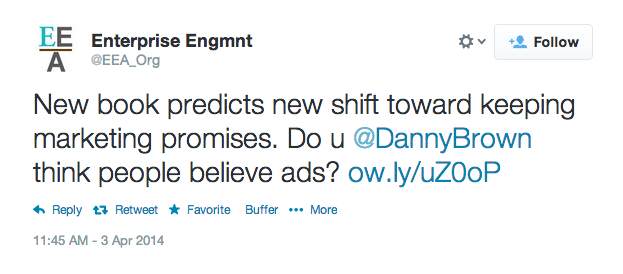
Get one wrong, and the other can follow suit pretty quickly, and make you look foolish – which is exactly what the so-called “Enterprise Engagement Alliance” looks like with their current outreach tactics for one of their books.

Check out this tweet from them.

EEA spam

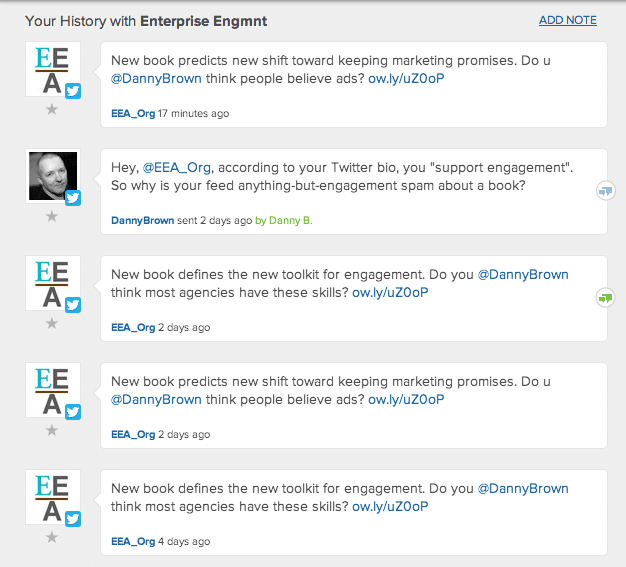
Seems innocuous enough, right? They have a new book, and they ask a question regarding the topic in order to pique interest. Except, it’s not innocuous, as this grab from their stream shows.


While there might be slight differentiations in text, the result is the same – sandblasting out tweet after tweet after tweet, regardless of audience, interest, and accepted best practices for outreach today.

For an organization that claims to have engagement at the fore of their efforts, their Twitter feed sure goes against that premise, as shown by my attempt to reach out to them about their methods.

Enterprise spam

Instead of getting an answer, I simply got more of the same crappy spam blasting that makes me believe Enterprise Engagement Alliance represents not engagement, but everything that’s wrong about brands that just don’t “get” social media.

A Lesson in REAL Engagement and Outreach

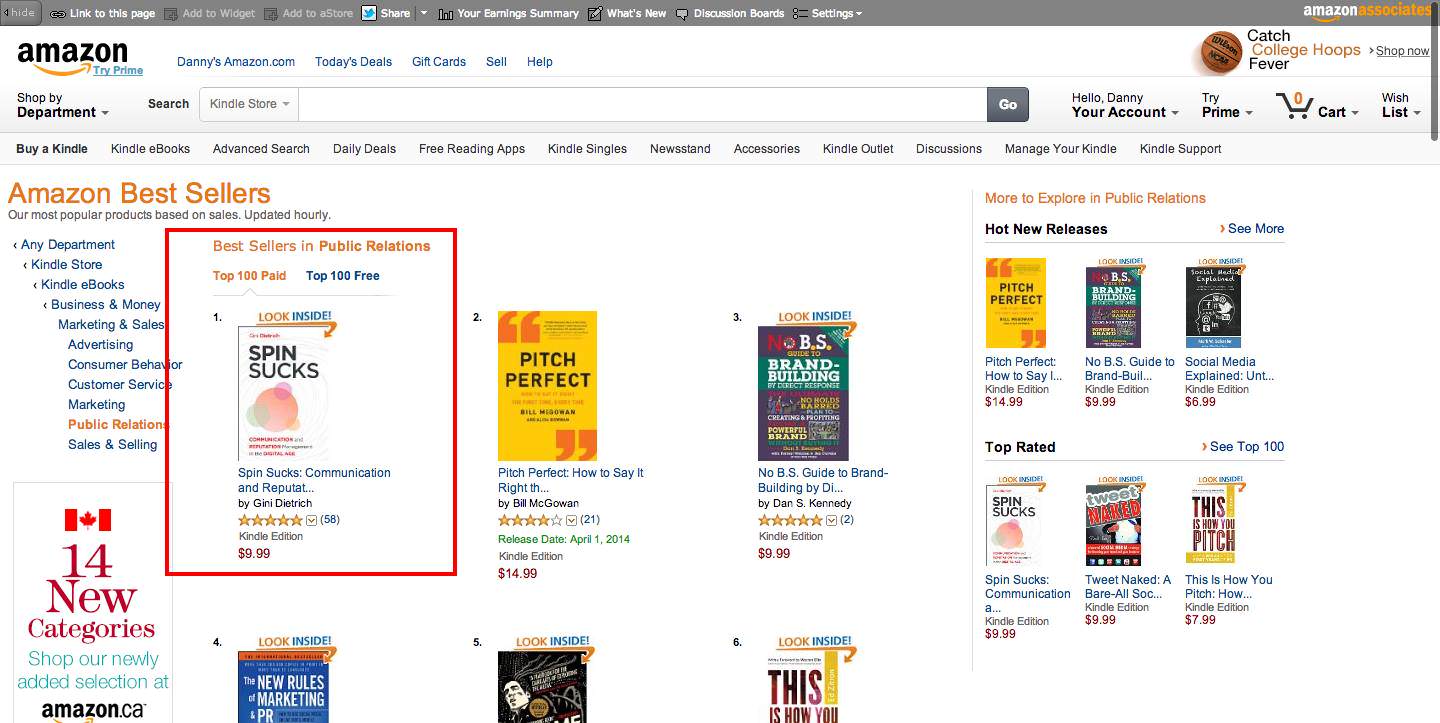
Compare EEA’s approach to that of Gini Dietrich, and how she promoted her new book, Spin Sucks, and worked with her target audience to help her own the PR category on Amazon on launch day and continues to sit high in the rankings today.

  • She created a treasure trove of value for anyone who bought the book;
  • She created a social media sharing resource with potential tweets, updates, rich media and more;
  • She created an easy-to-use Facebook app to spread the news;
  • Most importantly of all, she made it easy for her audience to be Spin Sucks brand ambassadors and really be part of the book’s success.

The results speak for themselves.

Spin Sucks launch day

Now, given, Gini’s a professional whose business is all about crafting the right message and best way to communicate that message, so you’d expect her to be a pro at this.

But that just makes the approach from EEA all the more disappointing – after all, this is an organization who has been quoted as being able to,?“…someday rival advertising in scale.?

It just goes to prove, being bigger doesn’t mean being better – and saying one thing but doing the complete opposite simply erodes any belief that your business is up to the job of doing what the bio on your spam-laden feed says you can do.

image: Lamda Chi Alpha Fraternity

Can We Say Goodbye to These Social Media Buzzwords in 2014?

sticky content

When it comes to social media, 2013 was a pretty watershed year for brands and platforms alike.

Oreo won widespread praise for the way it took advantage of the power outage at the Super Bowl with its?“You can still dunk in the dark” tweet; Google’s nascent Google+ platform?broke the 500 million user barrier; and social channels continued to play key roles in political uprisings, as?witnessed in Brazil this past summer.

However, with all the positive steps of a maturing social media comes an inevitable byproduct: overhyped buzzwords. From prefixing (and suffixing) the word?marketing, to feel-good soundbites that had little real-business benefits behind them, 2013 will be remembered as the year that social media became home to some of the most annoying and overhyped buzzwords online.

Here are the top five as crowdsourced from across the Web.

1. ‘Lessons Learned From’ Blog Posts

Whenever there’s a crisis on social media channels?or an offline crisis that’s amplified via social media?you can pretty much guarantee that within 24 hours there will be a batch of blog posts published with titles such as, “What Crisis X Can Teach Us About Business” or “Lessons Learned from the Brand X Social Media Crisis.”

While some of these posts may offer value, many are simply jumping on the bandwagon to drive traffic to their blogs, without actually offering any deep or insightful lessons. This has led to a strong feeling of apathy and sarcasm directed toward the authors of these posts.

“Everything is not a lesson, especially natural disasters, terrorist threats, and anything that happens to a bunch of people at once. Stop exploiting tragedy for profit.”?Tinu Abayomi-Paul, chief visibility officer at?Leveraged Promotion

2. Everything Is Dead!

You’ve probably heard the conversations online: SEO is dead. Print is dead. Advertising is dead. PR is dead. Email is dead. And so on. It’s almost impossible to browse your Twitter feed or Google+ stream and not come across a blog post or update with one of these statements being made.

And yet, here we are. SEO is still here; print still has its audience; advertising continues to profit; PR is still a core part of any brand’s strategy; and email continues to lead the way as the preferred communication channel for business. Despite the naysayers?or perhaps, in spite of them?it would appear the demise they write of hasn’t quite happened.

“We need to stop implying that a certain practice is dead. Nothing really dies, it either adapts or recycles. The adoption curve goes from innovators to laggards and all need something at different stages.” ?Ann Marie van den Hurk, principal at?Mind the Gap PR

3. Go Viral

Perhaps it’s no surprise that brands want a viral hit, whether that’s a YouTube video that gets millions of views, or a piece of content that gets shared across every channel. After all, if you can come up with the next Old Spice Guy sensation, everyone can retire.

The problem is, the allure of viral?mass uptake by your target audience and those not yet aware of your brand?is the very thing that’s made viral overhyped, and hurts your chances for success.

“The allure of going viral is ultimately a distraction for brands because it focuses on marketing to the crowd. When you chase an elusive crowd you have no connection to in the hope of going viral, you’re setting your business up for failure. Viral campaigns tend to be one-offs with limited shelf life, and quickly fizzle out.” ?Allyson Kapin, founding partner at?RAD Campaign

4. Social Business

One of the most overhyped and overused social media buzzwords in 2013 was the term “social business.” A complete industry seemed to appear overnight, with agencies and consultants offering multiple definitions?a business that places equal value on employees as it does stakeholders; the culture, connections and participation of a brand; and being part of a “collaborative economy.”

However, this merely diluted the definition of?what it means to be a true social business?one that is created and designed to address a societal problem, and is a non-dividend company where profits are reinvested in the business or used to start another one with the aim of increasing social impact. That’s a far cry from the corporate definition being touted in 2013.

“A hijacked phrase, and nobody can agree on the definition of the new version.” ?Doug Haslam, senior account director at Scratch Marketing

5. Brand Storytelling

People like stories. From early cavemen sitting around a fire to the likes of Hans Christian Andersen, stories have the power to captivate audiences and keep them lost in that moment. It’s into this arena that brands have started to promote their own history and goals through the medium of storytelling. At least that’s their attempted goal.

The problem is, storytelling needs that emotional impact to truly connect. And many brands who are now telling their stories miss that key tenet, and instead of captivating an audience, drive it away through clearly forced and weak attempts to connect.

“Storytelling is a true art, an essence that’s hard to capture. You can’t expect others to see it or feel it unless you deliver it properly. When we try to market through storytelling, I don’t think many know what that really means?storytelling is not interchangeable with copywriting.” ??Julie Pippert, founder and director at?Artful Media Group

Saturation Before Maturation?

When polling for this article, there were many other popular phrases that people consider overhyped: Web 3.0, content marketing, influence marketing?pretty much anything marketing that wasn’t simply marketing?big data and more.

While social media matures as a business solution as well as a societal one, it continues to go through growing pains. Overcoming overhyped buzzwords is clearly going to be one of those pains.

How about you – what buzzwords got your gander in 2013? Share them below!

A version of this post originally appeared on OPENForum.

A Conversation About SEO, Social Media and Content Convergence

Convergence

A few months ago, I sat down with Steven Sefton, Digital and Social Media Director for Think Zap, to discuss a variety of topics including the changing face of marketing; where different verticals fit; how the UK and North American markets are different; where influence marketing is heading; and much, much more.

Below, you can find part one of that chat (which originally appeared on The Social Penguin), centred around the shifting face of marketing, and how demographic buyer differences between the UK and North America impact tactics.

I hope you enjoy, and you can find the concluding part here.

————————–

Are companies truly embracing social media (or at least?seriously considering it) or do many still think it?s a fad?

Danny: No, although it?s much better than it was just a year or so ago. The problem?remains poor information and conflicting advice. ?Be everywhere?, ?be focused?,??blog?, ?don?t blog?, ?social media is owned by marketing?, ?social media is?owned by everyone?. And on, and on, and on?

When you have that kind of confusion coming at you from all angles, you can see?why businesses are unsure on what to do next. Combine that with the continued?and very wrong assumption that social media is purely for relationships, and you?can?t ? shouldn?t ? measure ROI on it, and I?m surprised any businesses are even?considering social!

The good thing is, there are some very smart people trying to change the?conversation and move us away from the warm fuzz mindset that so many?consultants are clinging to as their business model. The trick is in getting these?people heard, versus those with the easy soundbites.

What was the last social media campaign that was a success in your eyes?

Danny:?I?m going to cheat a little here, and share the one we used as the case study in the?opening chapter of our book.

MV-1 Canada was trying to launch their dedicated,?as opposed to retro-fitted, mobility vehicle into Canada.?With limited budget and?no market penetration, they used our model of influence marketing, combined?with social campaigns as well as on-foot outreach, and gained a 20% market?share in the first 12 months of sale.

For anyone that says social media doesn?t?equate to real business ROI, I respectfully suggest they think again.

They say social media and digital in the UK are lagging behind our northern?American friends. Do you believe this?

Danny:?I think it depends ? there are some great agencies and consultants in the UK.?People like Shannon Eastman, Paul Sutton, Andrew Burnett and more like them?are paving the way for some really great forward thinking.

And in Canada, I?d say?many businesses are lagging behind their American and UK counterparts, often?because of the longer buy-in cycle that many Canadian businesses have, as well?as the reduced budgets compared to their US counterparts.

It?s like most things?? there are great examples and there are poor examples. I think the greater are?starting to outweigh the poorer, and these countries are getting much closer to?each other.

How does social media and digital work compare in general by brands and?agencies from the UK to Northern America?

Danny:?I find the UK is still very much focused on email as the lead social marketing tool,?versus say an influence campaign or a social marketing one across networks.

This ties into UK social users preferring email as their primary means of?communication from retailers, versus social channels.

Buying signals are also very different. UK consumers are still very much geared?towards connecting with companies for discounts and low-cost goods, whereas?in the NA market, consumers need more data and information before they?commit to offering up their contact details. It?s a very two-way thing.

This means NA marketers need to have a far more tangible offer than a simple?discount or special offer, while UK marketers have a slightly easier buy-in. This?would suggest the loyalty factor would be something that NA brands focus on,?versus the stack-?em-high, sell-?em-cheap UK marketplace.

Many companies are still finding it hard to merge the different departments?within an organisation. How can companies manage the link between PR, Social?and SEO?

Danny:?By understanding they all need each other. There are still too many silos?within businesses of all sizes, not just the bigger organisations. Companies?that understand this and break down these silos are the ones that enjoy bigger?success, because they understand the strengths of a fully integrated approach.

Different consumers use different methods to research, connect, purchase and?review. If you?re still focusing on one core method over another, you?re going to?miss these nuances and then wonder why your conversions sucked.

True influence webinar

Understand that all three disciplines work better when aiming towards a?common goal. Let?s face it, it doesn?t really matter which department you feel?should lead ? every single one?s goal should be both the short and long-term?success of the business. Gelling currently silo?d departments together isn?t just?common sense, it?s business acumen sense.

How do you see SEO, social and content converging in the future?

Danny:?There won?t be any divergence ? there shouldn?t be today. It?s all marketing, pure?and simple.

  • SEO ? traffic to a destination for the goal of conversion (marketing).
  • Social ? building two-way conversation for brand awareness that evolve?into customers (marketing).
  • Content ? thought leadership and advice for the purpose of attracting?readers to your destination to evolve into customers (marketing).

Buzz words like content marketing, social marketing and yes, influence?marketing, are simply soundbites that take away from the simple fact that it?s all?still just marketing. That?s the hub ? everything else is the spoke that?s used as?and when needed.

It’s about how we use social search to define local SEO queries; how paid media drives social activity; how content educates and supports brand acquisition, whether that’s social ads, PPC, SEM, etc. There’s no separation – it’s simply marketing with a common goal.

Realise that, and we don?t have to worry about silos and how?disciplines will converge.

Don’t forget to check out the concluding part of this interview here.

image: Rubin Starset

Social Media, Bullying, and the Growing Lynch Mob Mentality

One of the biggest benefits of social media, whenever you raise the topic of what changes social media has enabled in the bigger picture, is that of freedom of voice for everyone.

No longer are brands the only ones who have a pulpit to spread a message. Now, everyone from non-profits to small businesses to individuals have the ?same opportunities to say something and have that message spread far and wide.

On the one hand, this is a great leveller – if brands are guilty of questionable practices, now they can be held accountable through blog posts, public forums and social communities.

Yet, as much as this is the positive side of social media’s democratization of the web, it also allows anyone with a social account and an axe to grind to wield that axe more powerfully.

Often, they’ll use the argument, “But it’s free speech, I can say what I want.” And, to a degree, that’s true. Yet it’s also not quite as simple as that. Hiding behind free speech won’t stop you from being sued for your opinion; nor will it protect you in court under journalism rules.

However, that kind of free speech is usually used for opinions and counter-opinions.

It’s when that free speech moves from strong opinion into hate, vitriol and bullying that the bigger problem arises. And it’s a problem that seems to be escalating.

The Bear Pit Frenzy of Social Media Mobs

If you’re online in any capacity, you’ve probably heard of the Justine Sacco case. A high-flying executive with a global agency, she was leaving for Africa when she tweeted out the following:

justine-sacco-aids-tweet

While the tweet was offensive and idiotic, and was rightly condemned (Sacco was fired from her position), what followed on social, especially Twitter, was just as offensive.

Instead of criticizing the tweet, and looking at ways to offer perhaps education or counterpoints to the racist overtones, the hate mob descended.

Twitter-DunkDa_G-My-Africans-gonn-rape-u-n-leave-... Twitter-Phislash-Somebody-HIV-must-rape-this-...?Anger at the tweet is understandable, especially if it’s your country that’s been tarnished. Hate and condoning sexual assault, though? Is that even excusable?

Some saw it as an opportunity to get their own racist point of view in.

Twitter-WhiteRightNet-Blacks-are-murdering-white-...

While there were examples of people calling for an end to the vitriol, it continued, and instead of a moment of clarity where we could have discussed racism and using social media to counter it, we were left with a lynch mob that seemed to delight in adding even more to the levels of bullying that were already forming.

Yet perhaps this shouldn’t come as a surprise.

When We Glorify Bullying

In late November, just a few weeks before Sacco tweeted her infamous update, the producer of The Bachelor TV show, Elan Gale, tweeted about his kerfuffle with a fellow airline passenger.

Gale was trying to get home for Thanksgiving and the plane had run into issues on the ground. His following tweets were directed at a passenger named “Diane”, who was agitated about missing the family dinner. Gale thought it was selfish of her when so many others were in the same boat.

What followed was a note exchange between the two, that escalated into insults and then this note by Gale, which he tweeted to his followers:

So a guy has a falling out with someone, a stranger in a public place, and resorts to sexual slurs to antagonize her? Which is then celebrated by over 2,600 people who favourite it. And elicits tweets like this:

Twitter-theyearofelan-My-response-to-Diane-in-7A-... Twitter-KarleeKanz-theyearofelan-Selfish-little-...

Thankfully(?), the exchange between Gale and Diane never happened – Gale later confessed he made it up. However, the perceived bullying via the sexual slur, and the fact so many people celebrated it, perhaps offers an idea as to why social media is fast turning into a megaphone for lynch mobs.

Free Speech Or The Road to Bullying?

As mentioned earlier, social media has been lauded for the way it allows anyone with a social footprint to share their point of view. The trouble with anything that offers this kind of untethered “freedom” is that it often leads to untethered hate.

Instead of needing the bravery (stupidity?) to face someone head on and in person, the web allows the comfort of a screen and being thousands of miles away from the target of their abuse.

Instead of leading to mature discussions around common goals, frustrations and injustices, it’s led to the bear pit mentality that we seem to be seeing more of. Ironically, as social media matures, the audience seems to be going the other way.

This type of “protection” has led to some tragic results.

The well-documented suicides of teens like Rehtaeh Parsons, a Canadian 17-year old who was raped and then mocked mercilessly on social media until she could take no more; or 14-year old Hannah Smith, who took her own life after months of bullying on social network Ask.fm.

It continues. Attacks on people for standing up to sexual inappropriateness; the escalation of?anger into bullying and death threats (much like the Sacco example earlier).

These are just some examples of where social media is being used as a bully pulpit.

Do insensitive and racist/bigoted comments need calling out? Yes. Does that mean any subsequent anger is okay to descend into bullying and mob mentality, though? A resounding no.

While we may feel it’s funny to latch onto a trending topic or viral event, it’s all too easy to forget in the heat of the moment what the eventual outcome may be.

And, as the sad cases of Rehtaeh Parsons and Hannah Smith and others like them shows, this pulpit doesn’t end with emotional upset by the victim…

image:?kid-josh

A version of this post was originally published on the Punk Views on Social Media blog.

  • « Go to Previous Page
  • Page 1
  • Page 2
  • Page 3
  • Page 4
  • Page 5
  • Interim pages omitted …
  • Page 55
  • Go to Next Page »
© 2026 Danny Brown - Made with ♥ on Genesis