• Skip to primary navigation
  • Skip to main content
Danny Brown

Danny Brown

podcaster - author - creator

  • About
  • Podcasts
  • Journal

social monitoring

Being Smarter with the Long Tail of Social Monitoring and Influence

digitalcity_0

When social media first began gaining popularity with brands, the first thing they wanted to know was, “What are people saying about us?”

It’s understandable – whereas before brands would only get to find out what the public’s perception of them was when the cash registers slowed down, now they could get insights on what was being said before it became a problem, and the perception of their response to that conversation (positive or negative).

This led to a booming market in social monitoring platforms. Companies sprung up with technologies that could monitor millions of conversations, send alerts to brand managers, and define the changing sentiment around a brand and the subsequent buzz that went with it.

All for a very nice premium, too, with licenses running into thousands of dollars per month for just a single license.

But the truth of the matter is social monitoring is flawed, and will continue to be flawed, while we still think in bits and bytes when it comes to human behaviour.

We Are Not Machines

The basic premise of a social monitoring platform is simple:

  • Choose your industry;
  • Choose keywords to monitor (brand, product, person);
  • Set up your alerts;
  • Define your goals (buzz, sentiment, volume, leads);
  • Gather data, report, refine, rinse and repeat.

Sure, there are other areas of data that brands may set up, depending on their goals – competitor intelligence, for example. But even this basic set-up of goals and tactics highlights the flaw in social monitoring – we’re hoping humans behave like machines to tell us what we want to know.

For most social monitoring platforms, the technology is still fairly basic in that all it does is monitor online conversations for certain keywords (much like Google scans the web for your search terms and then gives you a series of results).

The problem with this approach is it requires linear thinking on behalf of the target. Instead of true natural conversations like the ones you have with friends on Facebook, monitoring tools are often looking for non-connected scripts. Take the following example.

I’m in my house, freezing my butt off in a typical Canadian winter. I go online to moan, and say something as simple as “Being cold sucks.” There’s nothing really there for monitoring software to pick up. Or is there?

If the software was advanced enough, there are multiple reasons for me being cold. Is there a hole in my window? Is my roof insulation not working properly? Is my furnace broken? Am I struggling to pay heating bills?

Immediately, there are now four opportunities for four vendors to take an interest in me – glazier, roof insulators, HVAC companies and maybe even my bank, to see if they can help financially.

All from three little words, instead of a monitoring solution looking for me going online and asking “Know any good HVAC companies in Southern Ontario?”

You can see why we still have a way to go when it comes to monitoring. But that’s just a part of it.

Social Monitoring and the Influence Effect

Let’s take monitoring one step further, when it’s being used as part of an influencer outreach campaign.

When brands use influencers, they need to know who’s making the buzz happen and who’s creating action from intent. Otherwise, they’re just shooting in the dark while paying thousands of dollars to social scoring sites for putting them in touch with the influencers in the first place.

So, as a campaign unfolds, brands use monitoring platforms to see where the conversation is stemming from (influence solution partners can offer this information but you should be monitoring for your own needs as well). They track the times an influencer speaks, and whether this causes a trickle or ripple effect.

And this sets up another problem with monitoring at that high level – it doesn’t take into effect all the disruptive factors that help a decision be made, positive or negative.

Influencer disruptor paths

For example, I see an influencer talk about the new Ford F-150. I trust the influencer (he or she’s a car geek, just like me), and I like the mix of fuel economy and torque that the F-150 offers. I’m sold, and I mention as such to the influencer on their blog, so that goes down as a positive net.

But I’m not the decision maker when it comes to finances – my wife is.

So, as much as I love the truck and as much as I give off the vibe that I’m moving beyond intent to buy to actually buying, based on an influencer’s write-up, I don’t buy, because my wife has rightly said we need to go on vacation this year to unwind, and the money needs to go to that.

The effect of that decision isn’t felt, because the monitoring only stayed with me until I was a positive result for the brand and influencer. Had the monitoring or influencer program stuck with me for a week or two, they would have seen me jump online to say, “Vacation this year, truck next year.”

Instead, the brand wonders why there was a positive effect that didn’t correlate into a sale; the influence program is questioned for effectiveness; and the monitoring solution fails to follow up on my secondary conversation.

Take it one step further – let’s say the software really digs into who I’m talking with and can filter them into relevancy, as well as alerts if there’s a follow-up to our original conversation online. They would have picked up my wife speaking with her friends online and saying, “Danny wanted a truck, but we really need a vacation this year, so we’re doing that instead.”

The result would be immediate – the influencer program clearly worked, it’s just priorities that take precedence and, in this case, a vacation was a higher priority. But the message about the F-150 came through loud and clear and, had the vacation not been the disruptor in this case, the sale would have been completed.

We Need to Be Smarter with the Long Tail

Now, these are hypothetical examples, and there are companies that are trying to identify not just the main conversations, but the secondary and tertiary ones too. In our book, we highlight the ones we feel are making great inroads, and dedicate a chapter into using these platforms for your influence campaigns.

But as hypothetical as they are, they also clearly illustrate where we need to go, and that’s into the Long Tail of monitoring and/or influence. We can’t just stop at the result – we need to understand what made that result happen:

  • What diverted an action (my wife being the logic to my emotional decision);
  • Where the follow-up should be (in this case, reminders that I’m in the market for a truck in 12 months time);
  • What language tipped the emotional purchase (prior to the vacation becoming a disruptor);
  • Where the true result came from (in this case, a few weeks after the perceived success).

We’re not there yet, and while social scoring continues to be the lead when it comes to measuring influence online, we won’t get there anytime soon. The good news is, companies are moving away from scoring and really digging into all the data that’s available to us.

When monitoring catches up and combines its resources with the knowledge we get from identifying true influence, business will never be the same again.

Ready to start the next wave?
How to Use @JugnooMe to Make Social Monitoring Fun and Help Find and Build Brand Advocates

Jugnoo social crm

Jugnoo social crm

Over at Jugnoo, we’ve been tinkering away on a few updates to our solutions.

Between now and the end of September, there are even more cool updates being dropped in, and these will turn our dashboard into the fully-fledged offering that’s going to answer a lot of questions around social media, especially that all-important ROI question.

In the meantime, however, there are some pretty funky features and complementary tools that you can use right now. Case in point – social monitoring.

We all know how important social monitoring (or listening) is when it comes to your business or clients. Brand reputation, lead generation, customer service and more can all be optimized through a smart monitoring strategy.

The problem is, sometimes this can be very mundane and uninspiring. So, to counter that and make social monitoring a little more fun (while still helping get effective and actionable results), here are a few ways Jugnoo can help make things more fun.

Start Your Engines, Please

The first place to start is via our social search option. When you set up keywords in our platform, the most popular results are shown alongside your social analytics (for this example I’m just using Twitter – we also support Facebook and YouTube, with more platforms to come in the next release).

When you’re logged in the Jugnoo dashboard, click onto your social analytics icon and select your Twitter account. As long as you’ve set up a social search, you’ll see the keywords underneath your Most Popular Tweets (click to expand).

Twitter social analytics on Jugnoo

Click on the keyword, and you’ll be taking to the first fun part of the monitoring – our Tweet Visualyzer? (again, this will be expanded to feature more platforms in future iterations).

Once you’ve opened up the Visualyzer, the fun can begin.

The Simple (and Fun!) Way to Measure Buzz

One of the reasons we built our Tweet Visualyzer? was to make sense of the conversations on Twitter that can get noisy and confusing fast.

By separating the tweets into a simple and very visual solution, you can see what conversations are more popular, who’s having them and how they’re connected.

So, when you click your chosen keyword from the social analytics screen on the Jugnoo dashboard, you’ll see the same one on our Visualyzer. You can change views by using the top navigation, to switch from words to bubbles to usernames and more.

Now, let’s say you want to see who your biggest advocates are, so you can surprise and reward them with unique offers, or invite them to be official partners with your brand.

By clicking on the Who icon (the little head and shoulders guy), you can immediately see who’s talking about you the most:

Buzz who

In our example, you can see @FeastInc, @AtlasSymposium and @JeremyDeMello are three people who are talking about Jugnoo a lot. Hovering over their usernames, you can then see what exactly they’re saying about your brand.

This allows you to identify a potential approach to partnership, or see what kind of stuff they like. This can help you find what would be a cool surprise and delight package to send them.

By knowing what they like and other preferences, it enables you to be smarter about your approach when reaching out to them.

Once you have that information, then you can really add to the fun yet effective monitoring options, and continue to build the fledgling relationship.

Hub, Hub and Away!

This is where the third part of the puzzle comes into play – the Jugnoo Social Hub?.

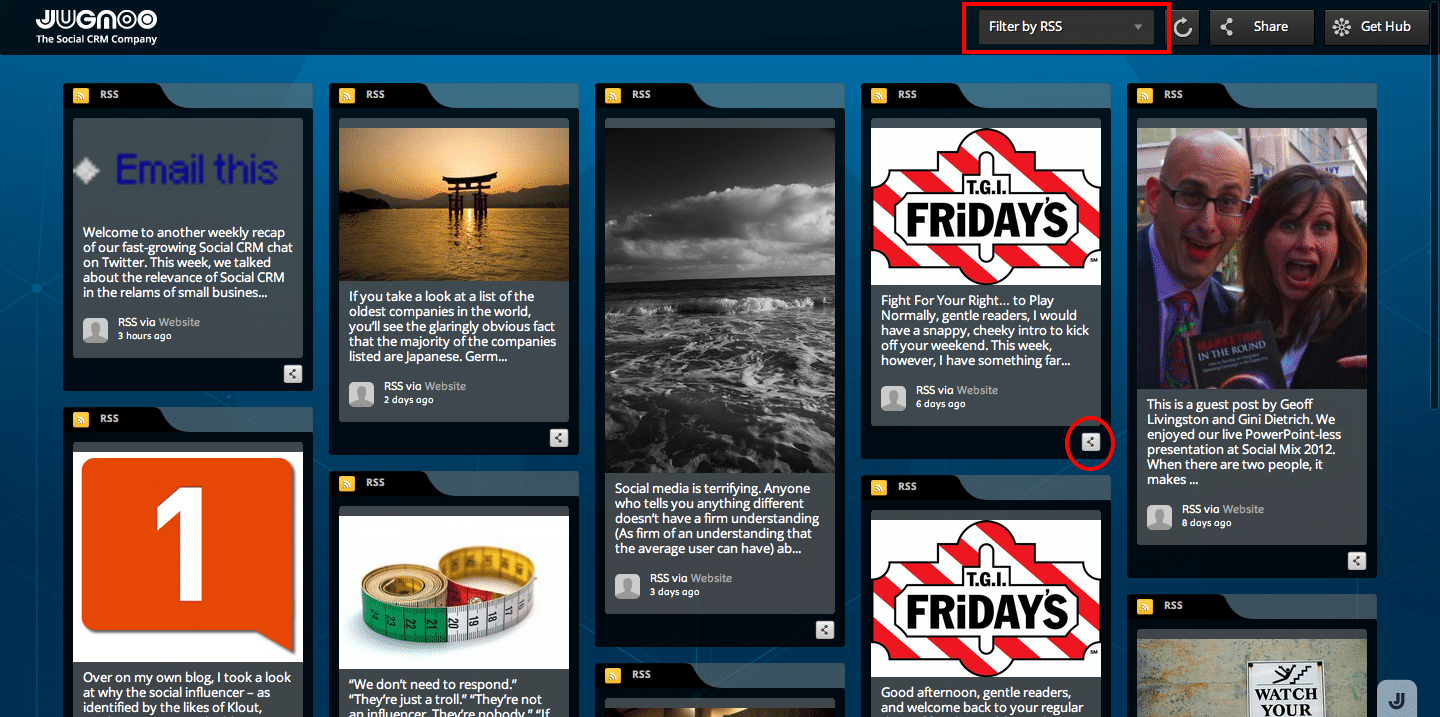
Kinda like a Pinterest board on steroids, our Social Hub? allows you to grab RSS feeds from various social networks and create a living, breathing hub where the most recent news around your choices can be displayed.

buzz RSS

Now, let’s say you want to connect more with the people talking about you from the Visualyzer results. You could set up a hub with feeds from their blogs, or Twitter account, or YouTube channel, etc, and use that to keep up-to-date with their latest updates or posts.

You can then reshare from the hub, send it as an email recommendation, tweet directly to the person, and more.

Let’s say @FeastInc, for example, tweeted that it was their pet’s birthday and you were a pet retailer. You could reply to them and wish them a Happy Pet Birthday, and then use the email function to send to your sales team and ask them to get in touch with @FeastInc to send them a goodie bag for their pet.

Or, you could see the URL for their most recent blog post, drop on over to leave a comment and mention the pet’s birthday in that comment too.

You’re building rapport; you’re showing you want to get to know them; and you’re rewarding for their support of you too.Who doesn’t like that?

These are just basic ideas using some cool tools that don’t even fall within the traditional social monitoring mix. When you partner them with the actual full social monitoring solution in the Jugnoo dashboard (released in the next 2-3 weeks) – well, the options become even more powerful.

And you still keep the fun factor of visuals, images and emotion, while making the connections that really count.

Works for me – you?

What?s Worth More to You ? The Cost of Your Reputation or the Cost to Monitor Your Reputation?

Online Reputation

Online Reputation

A few weeks ago, Heather Whaling shared the story of Nationwide and how they responded to what could have been a very difficult situation.

While there was still come criticism about the response possibly being less ?human? than it could have been from the various Nationwide accounts, it was still a great example of reacting quickly to douse potential flames.

It was also a great reminder that social media needn?t be scary for businesses worried about negative statements posted about them online (one of the biggest stumbling blocks for any business owner when it comes to social media).

This is especially true, given the low-cost entry to monitoring your brand and effectively responding to both criticism as well as praise. And yet companies still have a fear factor around social media ? so how can they overcome that?

Cost of Involvement versus Cost of Silence

One of the early phrases that came out of social media?s ubiquity was ?the conversation is happening whether you like it or not?.

This is probably one of the biggest reasons companies got scared to start with ? talk about a statement to put the fear of God in you!

The thing is, it should be the complete opposite ? conversations about brands have always happened. In the supermarket shopping with friends; over a beer in the local bar; chatting on the telephone; picking the kids up from school and talking with other parents.

These are the conversations brands should be afraid of, because they?re the ones they don?t get to see.

Social media, on the other hand, is so open and searchable that smart businesses can create searches based around their brand or products, and see exactly what?s being said; when it?s being said; and what the impact on the brand might be.

And it doesn?t need to break the bank, either, but can save the reputation of the brand in return, which has to worth any investment, no?

Consolidating to Keep Cost and Time Investment Down

Perhaps one of the bigger reasons that many businesses are still staying away from social media is due to the investment costs. Not just financial, but time investment too.

After all, while the tools ? for the most part ? may be free, it still costs money to set up a team (or monitor the platforms yourself). Add to that the fact you usually need to have multiple windows open to have all your networks covered, and it can become overpowering pretty quickly.

Yet it doesn?t need to be.

The rise of social media dashboards in the last couple of years have helped to consolidate several accounts into one area, which helps with the time suck factor.

Additionally, there have been great advances in the way online conversations are filtered, to ensure only the information you want is displayed, versus the blabber that may or may not be about you.

With social media dashboards, you can:

  • Link multiple social media accounts to keep track off.
  • Display full social feeds ? Twitter, Facebook, etc. ? to negate the need for separate windows for each account.
  • Track sentiment ? negative and positive ? about your brand so you can respond quickly (like Nationwide did).
  • Monitor keywords around your business, product and customer pain points to really connect with your consumers or users.
  • Track analytics to see where business campaigns are working and where they need more work.

Once you have all that information, you can begin to take control of your brand?s perception again, and grab the advantage needed over your competitor to stay both competitive and effective.

Throw in a social media dashboard that not only gives you all of the above, but lets you create Facebook promotions and marketing videos from within the admin area, and you couldn?t ask for anything more.

Just as well there?s a dashboard that does that, eh? ;-)

This post first appeared on the prTini blog.

image: ohmlabmusic

© 2026 Danny Brown - Made with ♥ on Genesis