Back in 2009, social media was just starting to become popular for marketers and brands to work with social media power users to promote their services and products.
Companies like IZEA saw an opportunity to attract people with large social followings or blog subscribers, and offer them money or free products for access to their audience.
Suddenly, Twitter was awash with tweets that were essentially ads, and blogs were rife with content that had been paid for. The problem was, no-one knew this because there was no legal requirement for that sponsored relationship to be disclosed. Instead, it was up to the blogger or “social influencer” to decide whether to disclose or not.
Due to the duplicitous nature of this lack of disclosure – essentially, it’s false advertising and gives brands an unfair advantage over competitors – regulatory bodies stepped in.
In the U.S., the Federal Trade Commission (FTC) published regulations stipulating paid or sponsored content had to be disclosed. Failure to do so would result in fines for brands in the region of $100,000 and up. Bloggers would be safe from this kind of fine (for now, at least).
In the U.K., the Advertising Standards Agency (ASA) is less forgiving, and sees bloggers equally as responsible as the brands they’re working for. If a blogger is found to have promoted sponsored content without disclosure, there are various sanctions they may face.
While I agree that bloggers who deliberately skirt the rules should be punished, I can’t help but feel the vendors they’re working with are letting them down. Case in point – Triberr.
Home of (Grey Area) Influence
Triberr started out as an automated content curation platform, where bloggers could join “Tribes” and share each other’s posts, the idea being to gain more traffic from the extra army of bloggers and their audience you’ve created a Tribe with.
Recently, though, Triberr pivoted and became the self-proclaimed “Home of Influencers”.

To their credit, they had an interesting approach – brands would create self-served campaigns (where they themselves created the timelines, offers, compensation, etc.) and then open it up to the relevant Triberr members.
Triberr wouldn’t charge for this service. Instead, they’d take a percentage of the final payout the influencers received. Compared to the costs involved with a Klout Perks campaign, this is a far more attractive proposition for both brand and blogger. The brand doesn’t have to pay exorbitant fees, and the blogger makes a decent income.
The problem is, Triberr doesn’t seem to be doing too great a job at educating on disclosure, as per the FTC, ASA and similar governing bodies in Canada, Australia and elsewhere. In fact, disclosure seems to be a bit of a grey area.
When the Blogger Doesn’t Know About Disclosure
I recently read a blog post by a blogger I’ve been reading for a while, about a brand offering a pretty cool publishing service for new media. As I read the post, it became pretty clear (to me) that it was sponsored content.
Things like contextual keyword linking (where a certain phrase is used as a hyperlink versus the brand name itself), the way the post flowed compared to this blogger’s other posts, and the fact it simply read like a non-connected promotion. To confirm my guess, I checked the link for the contextual keyword (mobile ready) and, sure enough, the URL was clearly a campaign link.
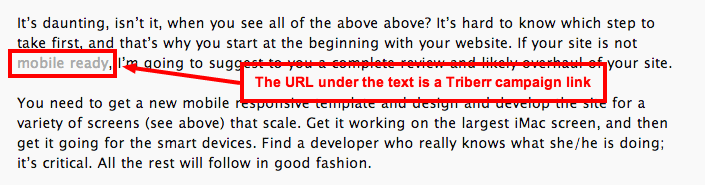
This would have been fine – had there been any disclosure to alert readers this wasn’t a normal post, but a sponsored one where a brand had paid the blogger to promote them. Unfortunately, there was zero disclosure anywhere.
I noticed that the blogger had more than one post about this brand, so I checked that one too. The same: contextual keyword with a Triberr campaign link, and no disclosure.
I decided to first hop on over to Triberr and see what they say about disclosure, but it’s pretty difficult to find anything if you’re not logged into their system.
I did find a blog post by Triberr co-founder Dino Dogan, that shares this advice about disclosure:
Disclosure is a hugely important part of brand ambassadorship.?They don?t have to be generic and boring. You don?t have to be ashamed of being affiliated with a company. In fact, if you are ashamed, you have a choice. You can go and represent a different company.
While Dino mentions the importance of disclosure, there aren?t any guidelines in the post on how disclosure should be approached. Indeed, when referring to a sponsored post Dino uses as a great example of a campaign post, he states:
Somewhere in the middle of the article I disclose how the post came about.
This is a red flag. As per the FTC mandate, disclosures should be highly visible:
- Prominence: Disclosures must be prominent, viewable on any device, and not buried within a web page (in the March 2013 update, the FTC stated disclosure must be at the start and end of each post). Fine print may not cut it, and prominence is even required on a mobile web page. (Source: Social Media Explorer)
The key phrases that stand out here are “disclosures must be prominent” and “not buried within a web page”. The post Dino referenced had the disclosure “somewhere in the middle of the article”.
That raises the question, if the vendor isn’t “doing it right”, how are the bloggers being educated on the role of disclosure for a Triberr campaign? Judging by their latest campaign fine print, they’re not.

As highlighted by the red box at the bottom of the campaign, it shares milestones and content expectations – but nothing about disclosure. I reached out to Triberr on Twitter a couple of days ago to ask about their disclosure policy:
How is @Triberr ensuring all sponsored posts disclosed? Just saw two campaign links, not disclosed, on PR blogger's posts.
— Danny Brown (@DannyBrown) December 10, 2013
With no response, I then contacted a blogger I knew to be working with Triberr to ask about their understanding of disclosure from Triberr, and this was the response:
Should bloggers know to do this? For sure! However, there’s an intense likelihood a writer has never been hired. Ignorance is naivet? in this regard. Companies using Triberr to reach influencers need to assume bloggers are unfamiliar with legal rulings. ?Triberr needs to write influencer guidelines for sponsored campaigns (their current “rules” are sketchy). Companies need to add their influencer guidelines to the mix. Bloggers need to both read and adhere to a disclaimer with approved language and positioning in each published piece.?No one wants to grapple with the law or be fined due to a simple inclusion of a disclaimer. Each of us needs to do a better job of protecting the other — bloggers, influencer networks (like Triberr) and those hiring and executing campaigns.
So, bloggers seem to be in the dark around what should and shouldn’t be posted. Perhaps this isn’t surprising – there really is no easily found disclosure area for bloggers to reference. The closest I found was from this FAQ sub-post (click to expand):

While it mentions a Declaration Post sets off a relationship with transparency, any visitors to the blog that are only reading the sponsored post and are unaware of the Declaration Post will still be unaware of the content being sponsored, thus leaving the FTC guidelines unaddressed.
But bloggers aren’t the target (at least not for the FTC – the ASA would beg to differ). Instead, the FTC is more concerned about brands – so how does Triberr educate its brand partners?
The Non-Existent (Public) Disclosure Education for Brands
To find out, I created a dummy campaign on Triberr using the self-serve campaign creator. I simply entered some “Test” copy for each of the campaign areas, and clicked through each next step until I got to the point where I could review my campaign before setting it live.
At no point did I receive any advice about making sure I was aware of disclosure rules and guidelines. Nor was there any copy provided by Triberr that I could use for my Fine Print area (where Disclosure would be a prime candidate for inclusion).
Instead, I simply had the opportunity to insert my own fine print, and then set the campaign live.

Because this is a self-serving campaign, the brand (me) would be putting themselves in jeopardy by not stating upfront that partner bloggers need to disclose in any content they share (and not just blog posts – social updates, too, if they link directly to the brand).
With fines of up to six figures, this is an expensive oversight on the part of Triberr. There needs to be clear and upfront education, advice, copy, etc., that pinpoints the requirement of disclosure and how to make sure your blog partners are aware of their responsibilities in this area. If that is currently there, it’s very difficult to find (I couldn’t, after an hour of going through various links).

Without this, Triberr’s bloggers are short-changing their readers through no fault of their own. Worse, the clients using Triberr’s influence marketing service are essentially breaking the law, and if a fine isn’t bad enough, the hit to their reputation could be.
I’ve reached out to Dino Dogan for the Triberr take on disclosure and how they’re educating and enforcing (if at all). I’ll update the post accordingly if I hear back.