Gen Y Isn’t Leaving Social Media – Are You Ready For Them?


A new study from the Pew Internet and American Life Project makes for interesting reading on Gen Y and their presence in social media/social networking.
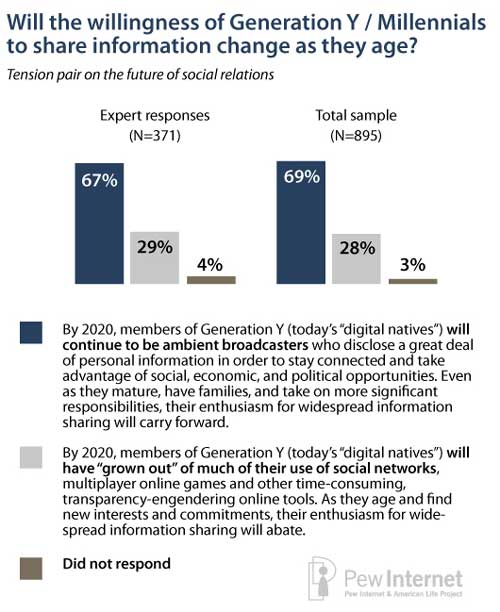
Pewter Internet Gen Y social sharing survey

Using the responses from a cross-section of 895 technology stakeholders and experts, including the likes of Clay Shirky and Jeff Jarvis, the survey shows their belief that Gen Y won’t be leaving social media anytime soon. This is in contrast to various opinions on why Gen Y isn’t using social media.

According to the Pewter survey, 67% of respondents agreed that Gen Y will still be using social media and be active on networks by 2020. Not only that, but their connectivity will have grown and, even in parenthood, they’ll be active and open members of various social networks.

29% disagreed, saying Gen Y will have outgrown their current online use (including gaming) as new commitments take up their time.

The reasoning for those 67% believing Gen Y will continue to grow their connectivity is the very reason many detractors use against social networking – its openness and ability to share information. Couple that with the benefits of growing brand reputation and it makes sense for Gen Y to continue being active users in the space (and continuing to grow in uptake).

So what does this mean for you, as a business owner?

The obvious answer is that you need to take a look at your current approach and see if you’re ready for this huge potential audience (for example, half of YouTube’s users are under 20).

  • Does your company have Gen Y employees on your social media team?
  • Can you employ a Gen Y community manager to communicate your message?
  • Are you social mapping to find out where your Gen Y customers are?
  • Is your sales message adapting to also include Gen Y tastes and needs?
  • Are you taking part in dedicated chats like #u30pro to understand what Gen Y feels about business, careers and more?
  • Are you reading blogs from the likes of Matt Chevy, Lauren Fernandez, David Spinks and Teresa Basich (amongst others) to understand this audience better?

While you might not be targeting Gen Y at the minute, they will be your customers of the future. Maybe it’s time to make sure you’re ready for that future now.

You can download the full Pew Internet report here.

Get my latest posts straight to your inbox!


DannyBrown.me runs on the Genesis Framework

Genesis Framework

Genesis empowers you to quickly and easily build amazing websites with WordPress.

Whether you're new to WordPress or an advanced developer, Genesis provides the secure and search-engine-optimized foundation that takes WordPress to places you never thought it could go. It's that simple - start using Genesis now!


Genesis comes with 6 default layout options, comprehensive SEO settings, rock-solid security, flexible theme options, cool custom widgets, custom design hooks, and a huge selection of child themes ("skins") that make your site look the way you want it to. With automatic theme updates and world-class support included, Genesis is the smart choice for your WordPress website or blog.

Post comment as twitter logo facebook logo
Sort: Newest | Oldest

I think a lot of the commenters are getting caught up on the wrong thing here.

I think it's pretty clear that social media has become engrained in the internet, and as long as any generation continues to use the web, they will continue to use these tools.

It'll take something very drastic and scare to get my generation to stop using social platforms. Of course, everyone will use them at their own rates. I'm sure many won't be as engaged in social platforms as others.

The fact is though, that the young people of today have grown up with these technologies. As long as "social" is tied to technological innovation, social will continue to develop and play a role in our daily lives.

David, Scribnia

The sample community here by definition is going to be very biased given they are answering a question where they already have the belief and a vested interest that Gen Y "not grow out if this".

Even if you asked only Gen Y people about this the data is still going to show only what they think they will do in the future.

None of us ever can be very accurate predicting our own future behaviors because it's always true that "you don't know what you don't know". This is especially true when asking people before they have kids what life will be like after they have kids. All of us with kids know they is no way to successfully communicate how drastically life and perceptions change when you become a parent.

Not saying that Gen Y'ers WILL abandon social media. I'm just saying that asking people what they will do in the distant future is dicey at best when it comes to accuracy.

A better approach I think is to try and divine the key ways social media tools will change and help business owners figure out how that will impact their consumers behaviors independent of age and era of birth

I am always cautious of the research that is founded on future predictions. I'm not sure we should be too hasty in basing our business decisions on what professionals think will happen in the future.

What is important, is what you think will happen in the future and find as much evidence as you can that assists your thought process and make the best decisions accordingly.

I think the "Gen Y isn't using social media" study is fascinating though again, I am cautious about the results.

Are Gen Y giving their right birth date on social networks or even providing it at all? I know many people don't like to disclose their age. I also wonder how accurate their calculations are considering the social networks don't freely give out the information of their users, as they shouldn't.

Trading financial markets for a number of years, I found more quality information came from talking with regular people than it did talking to the professionals about what they thought.

I think this is one of those circumstances. Finding out the reasons why Gen Y isn't using social networks, by actually talking to them, will help us make an informed decision about the future. Not asking the professionals who sometimes have a biased view from being involved in their own industries for so long.

Just my 45 cents...

The survey results are not surprising to me -- but what is surprising is who was surveyed.

From the report:

Many of the respondents are Internet veterans – 50% have been using the Internet since 1992 or earlier, with 11% actively involved online since 1982 or earlier. When asked for their primary area of Internet interest, 15% of the survey participants identified themselves as research scientists; 14% as business leaders or entrepreneurs; 12% as consultants or futurists, 12% as authors, editors or journalists; 9% as technology developers or administrators; 7% as advocates or activist users; 3% as pioneers or originators; 2% as legislators, politicians or lawyers; and 25% specified their primary area of interest as “other.”

In other words, I'll hazard a guess a small minority of the respondents consider themselves a member of Generation Y. I think this is an important aspect to consider, no?

Where I see gaming and social media might be different than game consoles and PC's. Gaming and social media is so much more.

Take for example Foursquares. Foursquares takes the idea of social media and gaming and marries the two together. If businesses, especially small businesses would take advantage of the gaming behavior, it would be a boom.

For example, award points to those who check in at your business. And those points would then in turn become discount points.

The ways social media and gaming could be used is limited only by a businesses own imagination.

I think a lot of the commenters are getting caught up on the wrong thing here.

I think it's pretty clear that social media has become engrained in the internet, and as long as any generation continues to use the web, they will continue to use these tools.

It'll take something very drastic and scare to get my generation to stop using social platforms. Of course, everyone will use them at their own rates. I'm sure many won't be as engaged in social platforms as others.

The fact is though, that the young people of today have grown up with these technologies. As long as "social" is tied to technological innovation, social will continue to develop and play a role in our daily lives.

David, Scribnia

It's good to see more data being added to the picture. I like everyone's skepticism because it indicates to researchers that there is a demand for good information.

I definitely agree. Although 2020 seems very far ways it's safe to say that Gen Y will most likely not abandon social media/sharing. Social media is still evolving and perhaps they will use social media differently in the future. However, to say Gen Y will out grow social media would be a stretch. Yes, their use of social media may mature but in my opinion it's here to stay.

Especially as the tools and platforms we currently use continue to evolve, and new ones come out, Kyle. Kind of difficult to outgrow from that perspective ;-)

The sample community here by definition is going to be very biased given they are answering a question where they already have the belief and a vested interest that Gen Y "not grow out if this".

Even if you asked only Gen Y people about this the data is still going to show only what they think they will do in the future.

None of us ever can be very accurate predicting our own future behaviors because it's always true that "you don't know what you don't know". This is especially true when asking people before they have kids what life will be like after they have kids. All of us with kids know they is no way to successfully communicate how drastically life and perceptions change when you become a parent.

Not saying that Gen Y'ers WILL abandon social media. I'm just saying that asking people what they will do in the distant future is dicey at best when it comes to accuracy.

A better approach I think is to try and divine the key ways social media tools will change and help business owners figure out how that will impact their consumers behaviors independent of age and era of birth

While I don't think you can dismiss the calibre of the respondents (not saying you did, Roger!), it's true that they are only predictions.

It'll be interesting to see how the "Internet as second nature" generation will/won't differ from previous generations who have had to work at adapting.

Does having to work harder offer a better understanding, or does second nature? Now that's the kind of information I'd like to see...

Agreed.

The question/hypothesis I think is important to look at....

- Is the rapid adoption and love of social networks by the population a transient, one time reaction to all of us having lived most of our lives without all this immersion in nonstop information/interaction?

- Were we all just really really dying of thirst for interaction so right now we are on a social immersion binge satisfying a thirst that will sometime in the near future be slaked enough for us to back down on drinking this all in?

It's like when you live in a place that has a bunch of really cool places to visit nearby but you never visit them because of the "Yeah but it's local so I can go anytime." effect.

So bottom line...how much of this craze is "binge drinking by freshmen college students" and how much of it is a sustainable "2 glasses of wine a day" consumption that will be stable over time when we all "grow up"?

-

Agreed.

The question/hypothesis I think is important to look at....

- Is the rapid adoption and love of social networks by the population a transient, one time reaction to all of us having lived most of our lives without all this immersion in nonstop information/interaction?

- Were we all just really really dying of thirst for interaction so right now we are on a social immersion binge satisfying a thirst that will sometime in the near future be slaked enough for us to back down on drinking this all in?

It's like when you live in a place that has a bunch of really cool places to visit nearby but you never visit them because of the "Yeah but it's local so I can go anytime." effect.

So bottom line...how much of this craze is "binge drinking by freshmen college students" and how much of it is a sustainable "2 glasses of wine a day" consumption that will be stable over time when we all "grow up"?

-

While making a prediction using the above data I think it is also important to address the fact that the way one engage with social media and vice versa will also evolve. By not taking this into consideration there could be some insight that will be missed out.

Agreed, Gautham. Like any survey or report, take what information might be relevant to you and cross-check with your own research.

I think you've missed a fundamental distinction here, between the information that social media users share in their use of the services, and the information that the services try to glean from their accounts, to share with PR and marketing types.

Users don't want their personal information shared with parasites, sorry, marketeers, and the recent debacle over Facebook's privacy settings showed this to be the case. The fact, which nobody in the SEO, marketing, bullshit business wants to admit, is that users are not, and will not engage with advertising, and are unlikely to engage wholly with brands or businesses in a social media setting.

Always nice to have a positive view of marketers in the comments ;-)

Having said that, you're talking about a very small percentage of an industry. There's crap in every industry - fast food, healthcare, leisure, etc. Unfortunately that's the ones most folks concentrate on...

I'd disagree with the "unlikely to engage with brands in a social media setting" viewpoint, though. There are a ton of examples around the web of brands that are succeeding in building their customer base through social, and it's not the usual suspects of big companies that can afford the investment, either.

It's not the platform that's deciding whether folks interact with brands or not; it's simply whether they like that brand to begin with.

I think the whole idea of "leaving social media" is flawed. The point here is that the web today is social by default... you can choose to share / broadcast what you want, but the ethos is unlikely to change, the social aspect, what I call "social everything", is going to remain, as it is human nature to want to be social. So, businesses just need to adapt to how best to interact in this space.

It's a valid point, Andy. We're all guilty of pigeon-holing platforms into nice soundbites; yet social media has been around for decades. It just has a shiny new name.

I am always cautious of the research that is founded on future predictions. I'm not sure we should be too hasty in basing our business decisions on what professionals think will happen in the future.

What is important, is what you think will happen in the future and find as much evidence as you can that assists your thought process and make the best decisions accordingly.

I think the "Gen Y isn't using social media" study is fascinating though again, I am cautious about the results.

Are Gen Y giving their right birth date on social networks or even providing it at all? I know many people don't like to disclose their age. I also wonder how accurate their calculations are considering the social networks don't freely give out the information of their users, as they shouldn't.

Trading financial markets for a number of years, I found more quality information came from talking with regular people than it did talking to the professionals about what they thought.

I think this is one of those circumstances. Finding out the reasons why Gen Y isn't using social networks, by actually talking to them, will help us make an informed decision about the future. Not asking the professionals who sometimes have a biased view from being involved in their own industries for so long.

Just my 45 cents...

Hey there Jay,

Your cents (no matter how many) are always welcome here, fella! :)

Agreed - don't base, but use as a platform to build from in line with your own research.

Though as I mention to Ari above, yes the majority of respondents might be biased to the platform, but they were the equivalent of today's Gen Y in their time. So maybe they're seeing some similarities we're not?

You are right to suggest that they can offer some insights we may not see ourselves. It is also possible they are recognizing many similarities to the past.

Re-reading my comment, it probably comes off as a little too direct. There is always value in hearing from the people that are well experienced in their field. Be it an opinion of what may be or a fact of what has been.

Not at all, fella - and even if it was, I prefer direct comments and thoughts as opposed to simply writing "Great post" and leaving ;-)

The survey results are not surprising to me -- but what is surprising is who was surveyed.

From the report:

Many of the respondents are Internet veterans u00e2u0080u0093 50% have been using the Internet since 1992 or earlier, with 11% actively involved online since 1982 or earlier. When asked for their primary area of Internet interest, 15% of the survey participants identified themselves as research scientists; 14% as business leaders or entrepreneurs; 12% as consultants or futurists, 12% as authors, editors or journalists; 9% as technology developers or administrators; 7% as advocates or activist users; 3% as pioneers or originators; 2% as legislators, politicians or lawyers; and 25% specified their primary area of interest as u00e2u0080u009cother.u00e2u0080u009d

In other words, I'll hazard a guess a small minority of the respondents consider themselves a member of Generation Y. I think this is an important aspect to consider, no?

It depends. If the report said, "Gen Y tells us they're here to stay", then it'd be misleading and you'd have to ask what the point behind it is.

As it is, it's a mix of folks that include Gen Y. It's simply a thought bubble based on current trends and future predictions, but given the calibre of the respondents, a thought bubble that might have more weight than some.

Where I see gaming and social media might be different than game consoles and PC's. Gaming and social media is so much more.

Take for example Foursquares. Foursquares takes the idea of social media and gaming and marries the two together. If businesses, especially small businesses would take advantage of the gaming behavior, it would be a boom.

For example, award points to those who check in at your business. And those points would then in turn become discount points.

The ways social media and gaming could be used is limited only by a businesses own imagination.

I think it's unlikely that after building up the habit of "broadcasting" their lives, my peers will suddenly grow out of that behavior. Interesting post and cool charts. I guess this will effect how I run my own business as I mature, but I'm not really targeting people above my age at base, so...

I just wanted to point out that saying gaming is a part of this is ridiculous, considering it hasn't stopped generation after generation of teens from playing video games before. Games founded on social networks (like Farmville), maybe, but the idea of "social games" isn't a new one. Games are social by default.

I think they're maybe looking more at Xbox Live and the PlayStation Network, Corey, and possibly PC gaming. That would make more sense since, as you say, gaming has been social from the start.

Especially with the tie-in to Twitter, Facebook and Netflix, etc, that these gaming networks now have.

Trackbacks

  1. [...] This post was mentioned on Twitter by Grant Griffiths and others. Grant Griffiths said: Gen Y Isn’t Leaving Social Media – Are You Ready For Them? http://bit.ly/9WwjOI By: @DannyBrown – RT [...]

  2. [...] Shared Gen Y Isn’t Leaving Social Media – Are You Ready For Them?. [...]

  3. [...] Gen Y Isn’t Leaving Social Media – Are You Ready For Them? (tags: social socialmedia) [...]

  4. [...] he die? Did he just decide that social media is so superficial that there has to be something better out there? Did he get a new job that necessitates that he not [...]